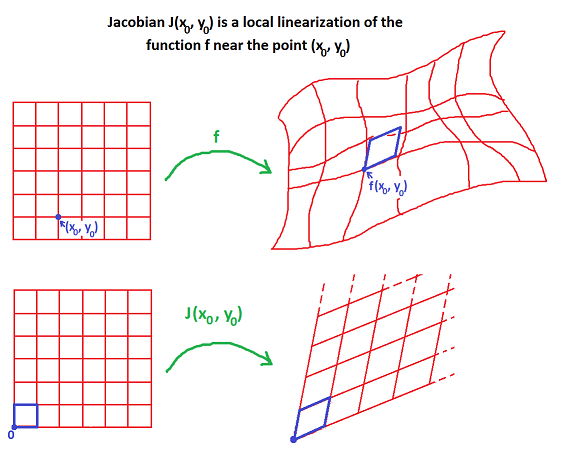
local warping intuition: the Jacobian captures how a tiny rectangle in -space gets stretched, sheared, and rotated into a parallelogram in -space. this works because nonlinear maps, when you zoom in far enough, look linear, so a small patch in gets approximated by a linear transformation, and that transformation is exactly what the partial derivatives encode. the determinant of that linear map is the factor by which areas scale under the local distortion, so if , a small patch in covers 3 times as much area in . everything else in the change of variables formula is just integrating that scaling factor over the whole region.
Polar, cylindrical, and spherical coordinates area form of substitution in multiple integrals. Let’s recall how Polar works:
Sketch
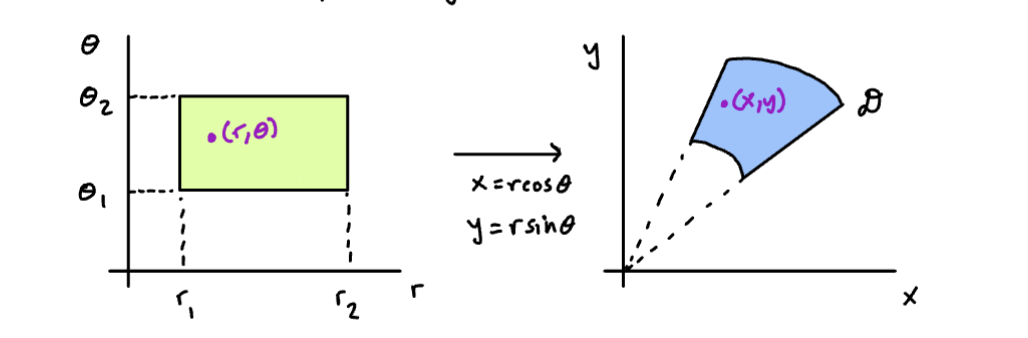
If is a polar region,
We know the area element is . The integration limits, and , correspond to a rectangle in the -plane.
In this document, we will learn how to find the area element/volume element, also known as the Jacobian Determinant, in the general case where the change of variable is given by .
Deriving the Area Element
Suppose the rectangular region , in the uv-plane corresponds to some integration region in the xy-plane under the substitution , .
Sketch
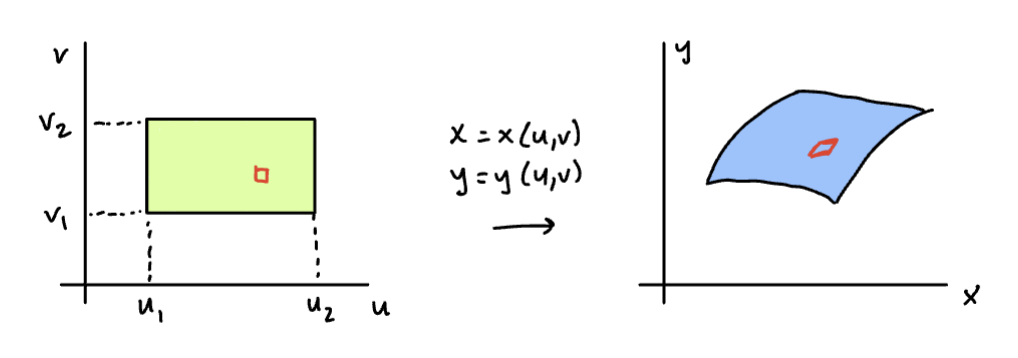
The rectangle with dimensions (the red square in the figure) in the uv-plane corresponds to a patch (the red parallelogram) in the xy-plane.
Sketch
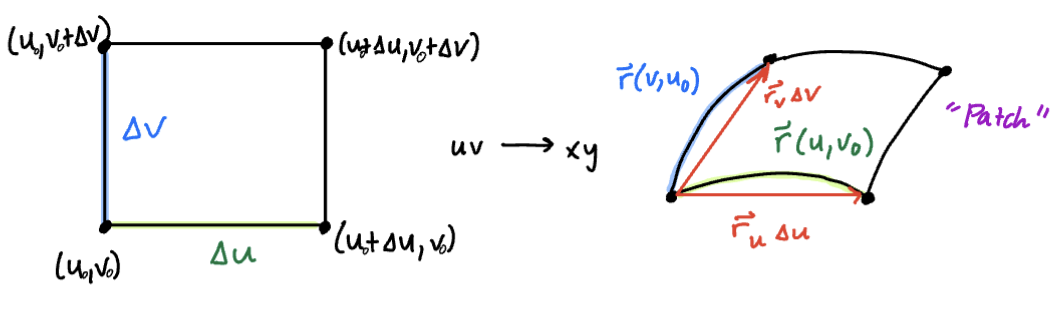
Suppose the red rectangle has bottom-left corner . Suppose the point is obtained by . Along the bottom line of the rectangle, varies and is held constant; this corresponds to the vector curve , where varies from to .
Claim
We can approximate the segment of shown in the figure by the vector .
Justification
By definition of the derivative:
Similarly, the segment of the vector curve is approximated by the vector , because along this curve we let vary and hold constant.
The area element is the area of the patch:
Adding up the area elements and sending the number of elements to infinity yields the result:
Change of Variable in Double Integrals
Suppose the region in the uv-plane is mapped to the region in the xy-plane by , . Then:
Where means the absolute value of .
Remarks
- We need to assume continuity of and the partial derivatives ,
- The quantity is called the Jacobian Determinant, which we can call . In 2D, we have:
The Jacobian “stretches” the rectangle to create the area element.
- If the Jacobian is negative, we take its absolute value in the integral ( the area element is positive)
Examples
Example
Evaluate the integral , where is the trapezoidal region with vertices
Solution
A suitable change of variable appears to be ,
Sketch
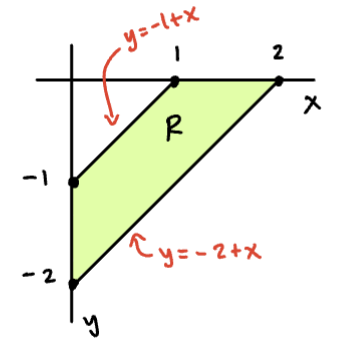
To sketch the integration region in the uv-plane: Observe that in the xy-plane, and . Therefore, we can range from to .
Bounds on u: We need to understand how maps to the uv-plane under the change of variable. We have already seen that the boundary lines and are constants. What about the other boundary line?
If , then and , so , where because
If , and , so , where because