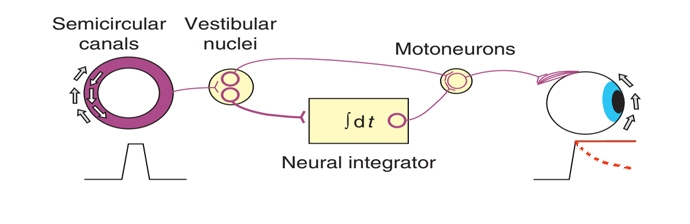
a Neural Circuit in the brain that accumullates and and stores motor/sensory information over time, converts input velocity into persistent output position.
- neural integrators in the oculomotor system are involved in the control of horizontal eye position across a wide variety of species, including fish and humans
Neural intergrators are actually line attractor networks. terms line attractor and neural intergrator are often used interchangeably, however they describe the difference between the network state space and the attractor space.
These networks are called ‘integrators’ because the low-dimensional variable (e.g., horizontal eye position) x(t) describing the network’s output reflects the integration of the input signal (e.g., eye movement velocity) v(t) to the system.
09-11-2026 Update: Sharing This Note for Path Integration
- Path Interation is an internal brain process that tracks location and direction by updating the self motion signals like that of speed and head rotation over time ( see the neural integrator example above, which uses this to keep eye stability despite head rotation ).
- feeds continuously into a Cognitive Map, helping humans/animals navigate space, calculate shortcuts, and update their positions without needing visual landmarks ( quite reminiscient of stuff with Grid Cells, Place Cells, and even the Kalman Filter under the odd context of its applications everywhere, see Coffee, Kalman Filters, and Predictive Coding )
NeuroMechFly v2 simulating embodied sensorimotor control in adult Drosophila (Wang-Chen et al., 2024) constructs biologically inspired controllers that use ascending feedback to perform Path Integration and head stabilization.
Bibliography
- Wang-Chen, S., Stimpfling, V. A., Lam, T. K. C., Özdil, P. G., Genoud, L., Hurtak, F., & Ramdya, P. (2024). NeuroMechFly v2: Simulating Embodied Sensorimotor Control in Adult Drosophila. Nature Methods, 21(12), 2353–2362. https://doi.org/10.1038/s41592-024-02497-y