- Self Attention focuses on seeing relevance of distant tokens to each other, however token ordering is still autoregressive for language; thus we have to inject position
- the most obvious solution is to just number them, first Token is a
0, next is a 1… etc. This almost works, but fails in a few ways
- grows without bound, so large position values can drown out the actual meaning in the vector
- a language model trained on short sentences has seldom seen position 5000, so this relies on generalization
- we want something bounded, unique per position, and something that understands relative distance
- The original Transformer used something called sinusoidal encodings
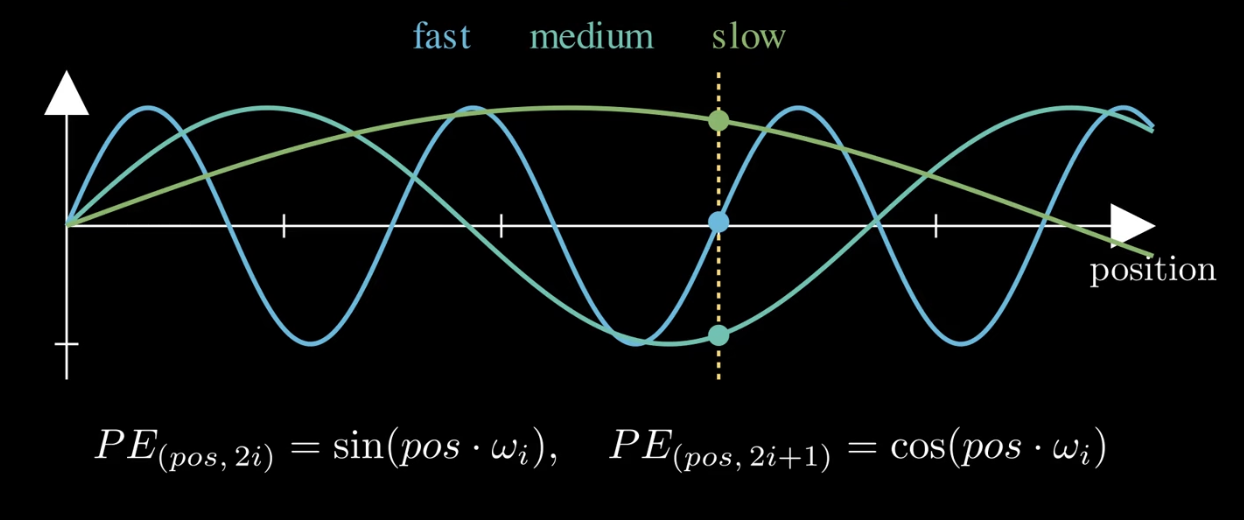
- instead of one number, use a bank of sine waves with varying frequencies
- like a clock with a second/minute/hour hand, they together pin down a unique moment
- encoding a position is as simple as reading the height of each wave at that position, yielding a unique fingerprint added to the embedding
- PE(pos,2i)=sin(pos⋅ωi), PE(pos,2i+1)=cos(pos⋅ωi)
- 07-28-2026 16:25 - Kimi K3 interestingly decided not to use RoPE and humorously said they use NoPE (No Position Encoding) in their technical paper.

- when computing k⋅q, rotate each pair of components in the query and key by an angle set by its token’s position
- their dot product then depends on relative position: the difference between the two rotation angles
RoPE(xpos)=xpos⋅cos(θpos)+x^pos⋅sin(θpos)
- for each pair (a,b) in x, the corresponding pair in x^ is (−b,a); each pair has its own frequency, with rotation angle θpos,i=pos⋅ωi