Many integration regions can be described conveniently in polar coordinates. Recall the meaning of the polar coordinate
MatPlotLib Example
import matplotlib.pyplot as plt
import numpy as np

# Values for demonstration (r = distance, theta = angle in radians)
r = 5  # radial distance
theta = np.pi / 4  # 45 degrees

# Convert from polar to cartesian coordinates
x = r * np.cos(theta)
y = r * np.sin(theta)

# Create figure and axis
fig, ax = plt.subplots()

# Plot the line representing (r, theta)
ax.plot([0, x], [0, y], 'brown', label=r'$\theta$ line')
ax.plot([x, x], [0, y], 'k--')  # dashed line representing height (y)
ax.plot([0, x], [y, y], 'k--')  # optional horizontal line for x

# Plot the point at (r, theta)
ax.plot(x, y, 'bo')  # blue point at the end

# Annotations for polar coordinates (r, θ)
ax.annotate(r'$r = \mathrm{Distance\ from\ Pole}$', xy=(x / 2, y / 2), xytext=(-5, 1.5),
            textcoords='offset points', fontsize=12, color='brown')
ax.annotate(r'$\theta = \mathrm{Polar\ Angle}$', xy=(x / 2, y / 2), xytext=(15, -10),
            textcoords='offset points', fontsize=12, color='purple')

# Annotations for Cartesian coordinates (x, y)
ax.annotate(r'$(r, \theta)$', xy=(x, y), xytext=(5, 5),
            textcoords='offset points', fontsize=12, color='blue')
ax.annotate(r'$x$', xy=(x, 0), xytext=(5, -10), textcoords='offset points', fontsize=12)
ax.annotate(r'$y$', xy=(0, y), xytext=(-15, 0), textcoords='offset points', fontsize=12)

# Set axis limits and labels
ax.set_xlim(0, r + 1)
ax.set_ylim(0, r + 1)
ax.set_aspect('equal', 'box')

# Axes labels
ax.set_xlabel('x')
ax.set_ylabel('y')

# Add the origin label
ax.text(-0.5, -0.5, 'Pole / Origin', fontsize=10)

# Show the grid and plot
ax.grid(True)
plt.title('Polar Coordinates vs Cartesian Coordinates')
plt.show()
Relationship to Cartesian:
Polar Coordinate Examples
Here are some sketched examples of polar coordinates:
Sketch
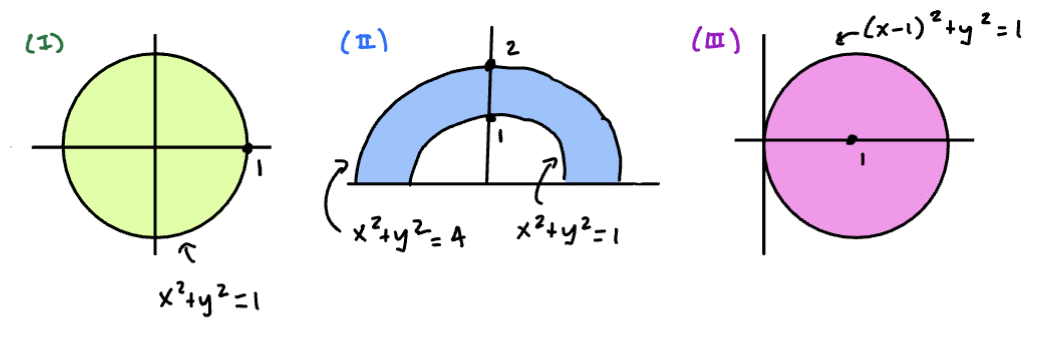
- The disk
- The semi-annulus
- The disk
The circle in the third example is given by:
Expanding and Simplifying:
Using conversion and
Double Integrals in Polar Coordinates
Suppose we wish to find the volume of the solid beneath the surface and above the region , where is described in polar coordinates. We seek:
where we have made the substitution , , and represents the area element in polar coordinates. To determine the area element, we must understand what it means to integrate over a polar region. The general polar region given by , where
represents the following sector:
Sketch
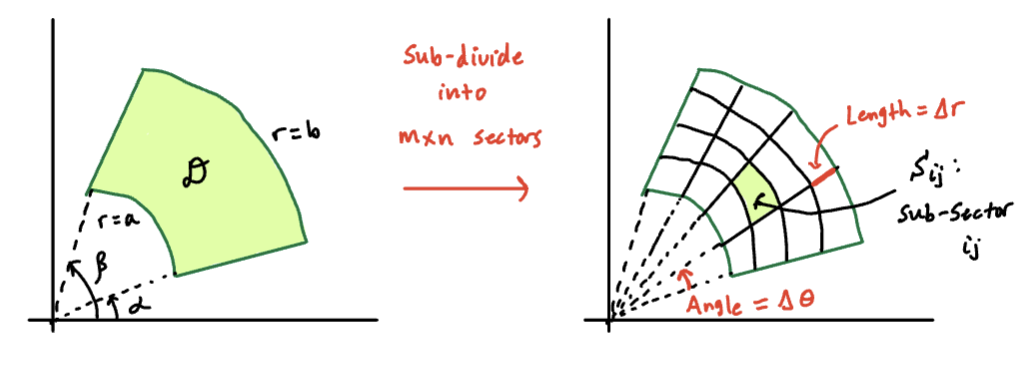
If we divide into sub-intervals of width , and into n sub-intervals of width , we obtain sub-sectors (see the right-side of the above figure).
Let’s determine the area of a sub-sector:
Sketch
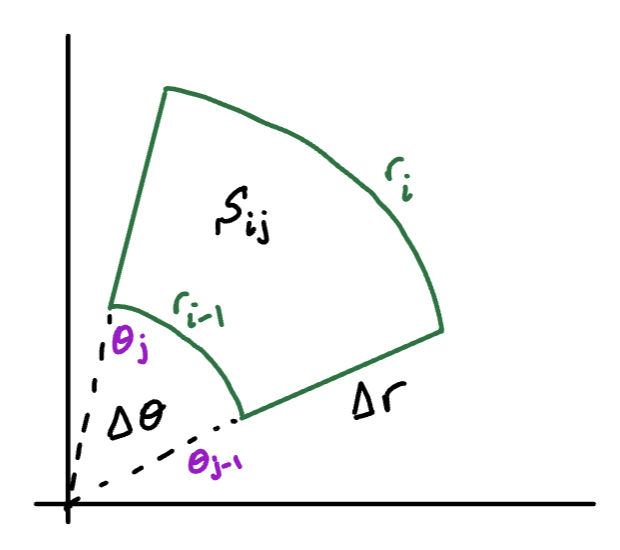
For very small and , the sub sector is nearly a rectangle with height and width equal to the arc length of one side of the sector. If we choose the “long” side, the arc length is
Therefore:
When we take the , the polar area element is:
Polar Area Element
Using this expression, we obtain the following:
Important
If is continuous on a “polar rectangle” given by , , then:
Observe the extra factor of r that must be included!
Examples
Example
Solution
We integrate in polar coordinates with respect to and , so we must determine bounds on and . From the figure at the beggining, can be described as:
We make the substitutions , , , into the integrand to obtain:
Carry out the integration:
We use the half angle identity:
Remark
The half angle identities will be useful for these problems:
The Gaussian Integral
We will now prove the famous result:
This is the so-called Gaussian Integral
Proof
Observe that:
(*)
because we can write the first integrand as a product of two functions independent of each other. The improper integrals on the right-hand side have the same value, so (*) says:
(**)
We will compute. the double integral on the left-hand side with polar coordinates.
The integration region is , , i.e., the entire xy-plane. In polar coordinates, we can describe the xy-plane by , . The Double Integral becomes:
Solving with I1 and I2
This is an improper integral of the first kind:
Using U-sub: means
Now for I2
Therefore:
Substituting into (**), We get:
Taking the square root yields the result.
Remark
We know it’s the positive square root because is a positive function.