Differential equations and initial conditions
A first-order ordinary differential equation specifies a rate of change:
is the independent variable; is the dependent variable. A solution is a differentiable function satisfying the equation on an interval.
An initial value problem (IVP) adds a starting value:
If the velocity depends only on time, , direct integration gives
is a dummy variable; is the endpoint. For constant velocity, .
For continuous , the general IVP can be written as
This is an implicit relation: the unknown function still appears inside the integral.
Exponential growth and decay
For constant ,
Differentiating verifies . The initial condition determines :
For example, gives . For nonzero initial data, the magnitude grows when and decays when .
| Model | Equation | Solution |
|---|---|---|
| Radioactive decay, | ||
| Cooling toward constant room temperature , | ||
| Population growth with unlimited resources, |
Order and time dependence
The order is the highest derivative present, regardless of its power:
An ODE involves derivatives with respect to one independent variable. A partial differential equation involves partial derivatives, such as and for .
An autonomous equation has no explicit time dependence:
A non-autonomous equation depends explicitly on time, such as .
Direction fields and equilibria
The direction field assigns a slope to each point . Solution curves are tangent to these slopes. For an autonomous equation, the slope is constant along each horizontal line.
For :
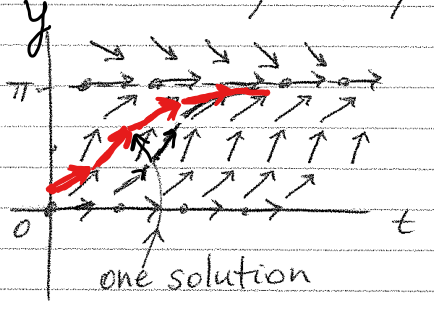
An equilibrium is a constant solution , so
| Equation | Equilibria |
|---|---|
| , | |
| None: no constant makes for every | |
| None over |
For , nearby solutions move toward odd multiples of and away from even multiples.