meant as an attempt to solve the reality gap (the discrepancy between simulated and real-world dynamics that causes sim-trained policies to fail on physical hardware)
The Golem Project
- Investigators evolved a robot to locomotive in simulation
- they are not just evolving the body, but the body and brain combined
- Manufacture robot using a 3d printer
- 3d printing is great, but it is limited to the static, plastic pieces of the process. All the active mechanical components still had to be added manually.
- snap in motors and complex components (human in the loop)
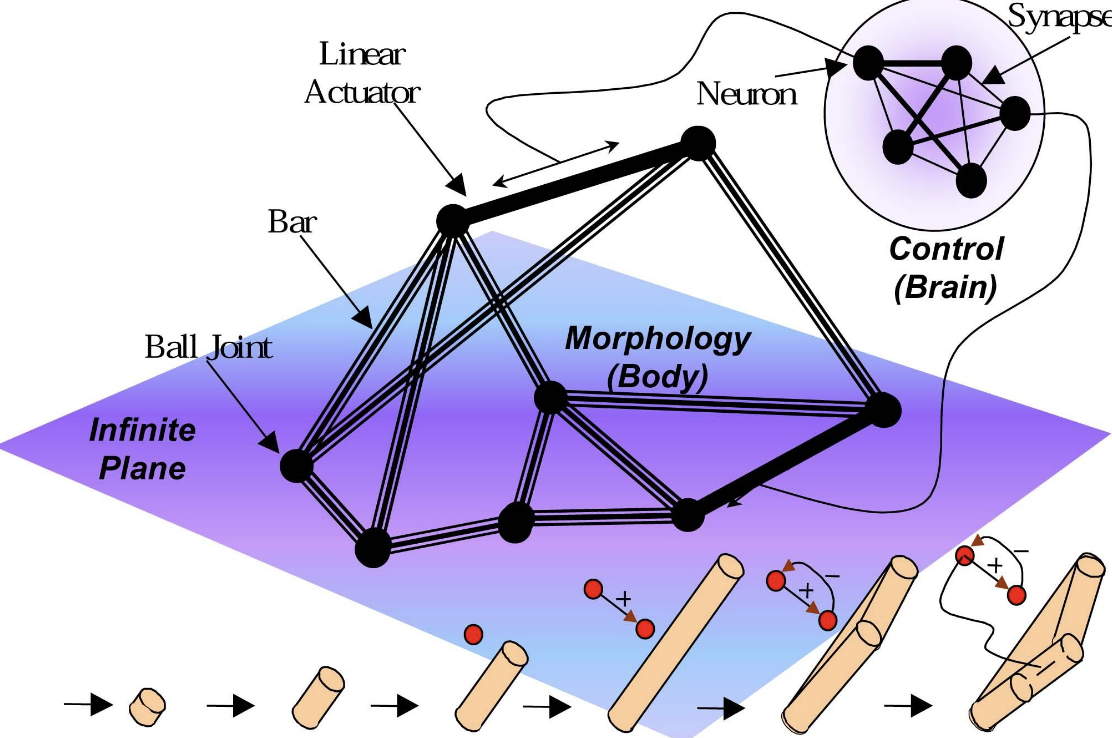
Genotype Encoding
a robot is fully described by its geometry, structural elements, neural network, and the actuators that connect them
a vertex is just a point in 3D space
a bar connects two vertices and has a rest length and spring constant governing how it resists deformation
a neuron fires when its weighted input exceeds its threshold, with one synaptic weight per incoming connection
an actuator ties a specific bar to a specific neuron and defines how far that bar can extend or contract
Parameters
Initial Population: 200 null genotypes
Fitness: Displacement of the center of mass
Evaluation period: “fixed number (12) of cycles of its neural control”?
Possible Mutations
pick random number between 1 and 10:
- change the length of a bar (10%)
- change a synaptic weight (10%)
- add or
- remove a dangling bar (1%)
- add or
- remove unconnected neuron (1%)
- split vertex into two and add a small bar (3%)
- split bar into two and add vertex (3%)
- attach or
- detach neuron to bar (3%)
One mutation was applied to each newly created genome. Every time a mutation adds a new neuron, all existing neurons add a synapse connection to that new neuron.
Some Results
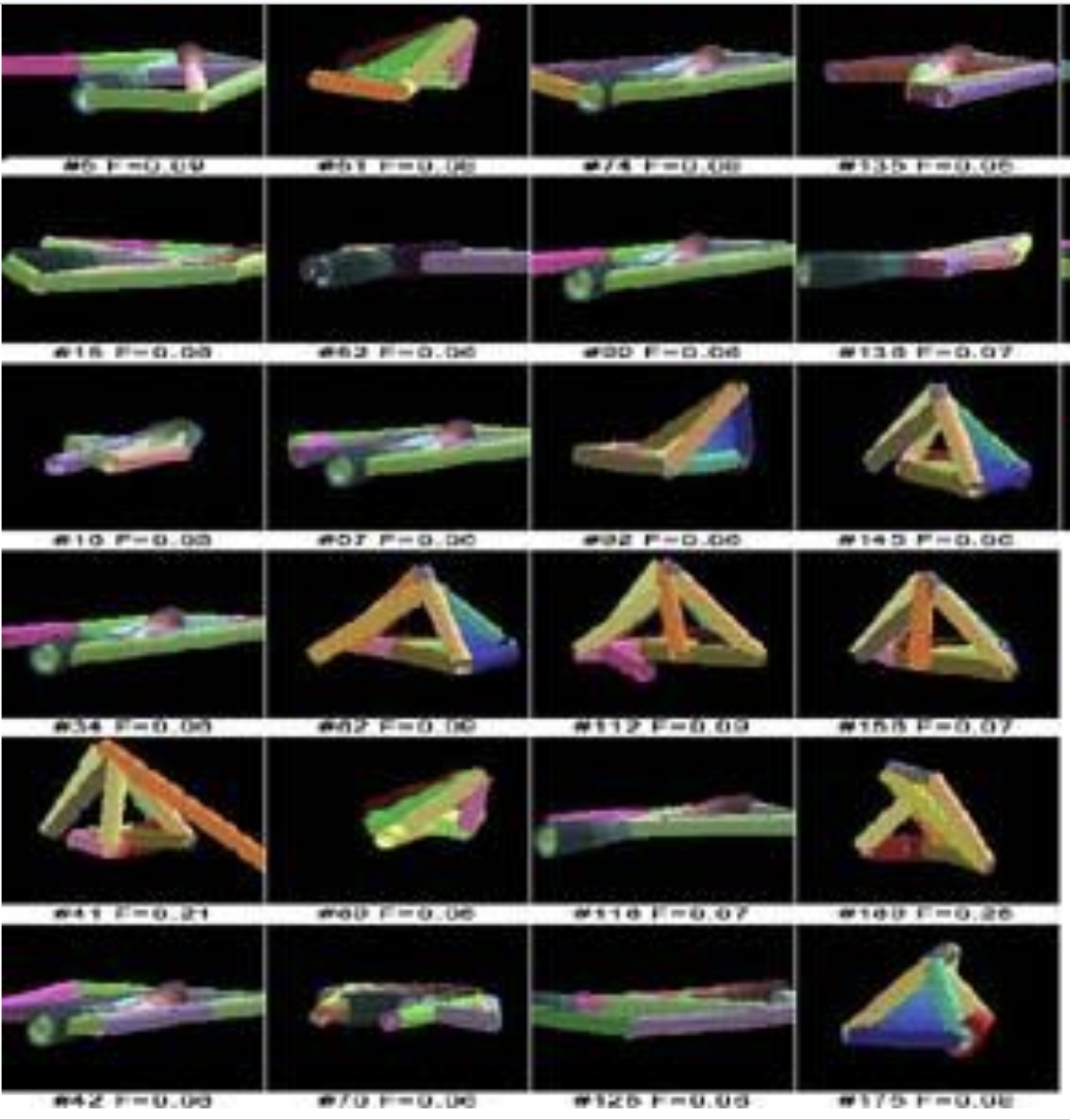
From one generation:
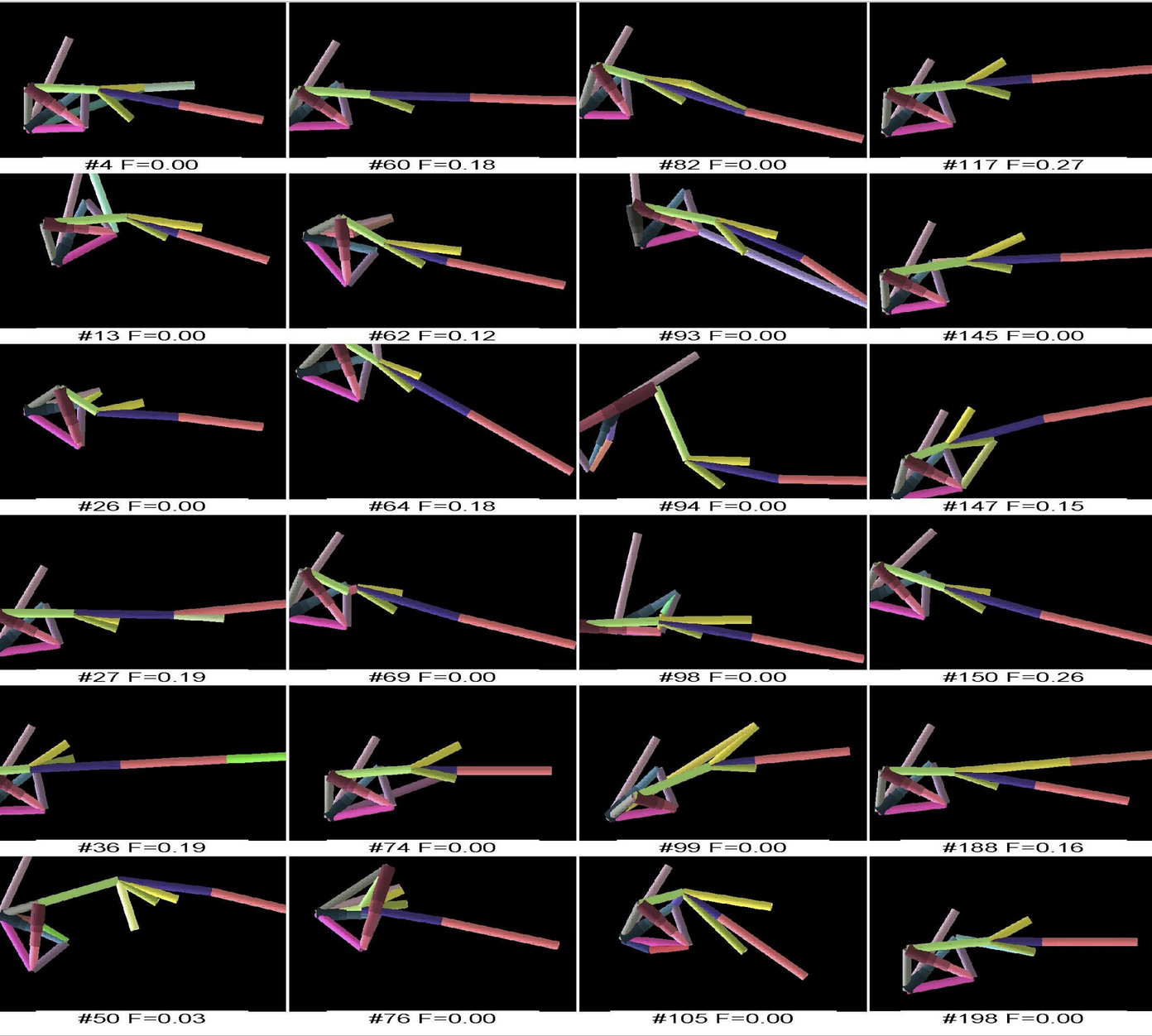
From varying generations across one “run”:
Phylogenetic Trees
Top to bottom is generation timeline, the links display similarity of ancestry. Gives a sense of which ancestors lead to success
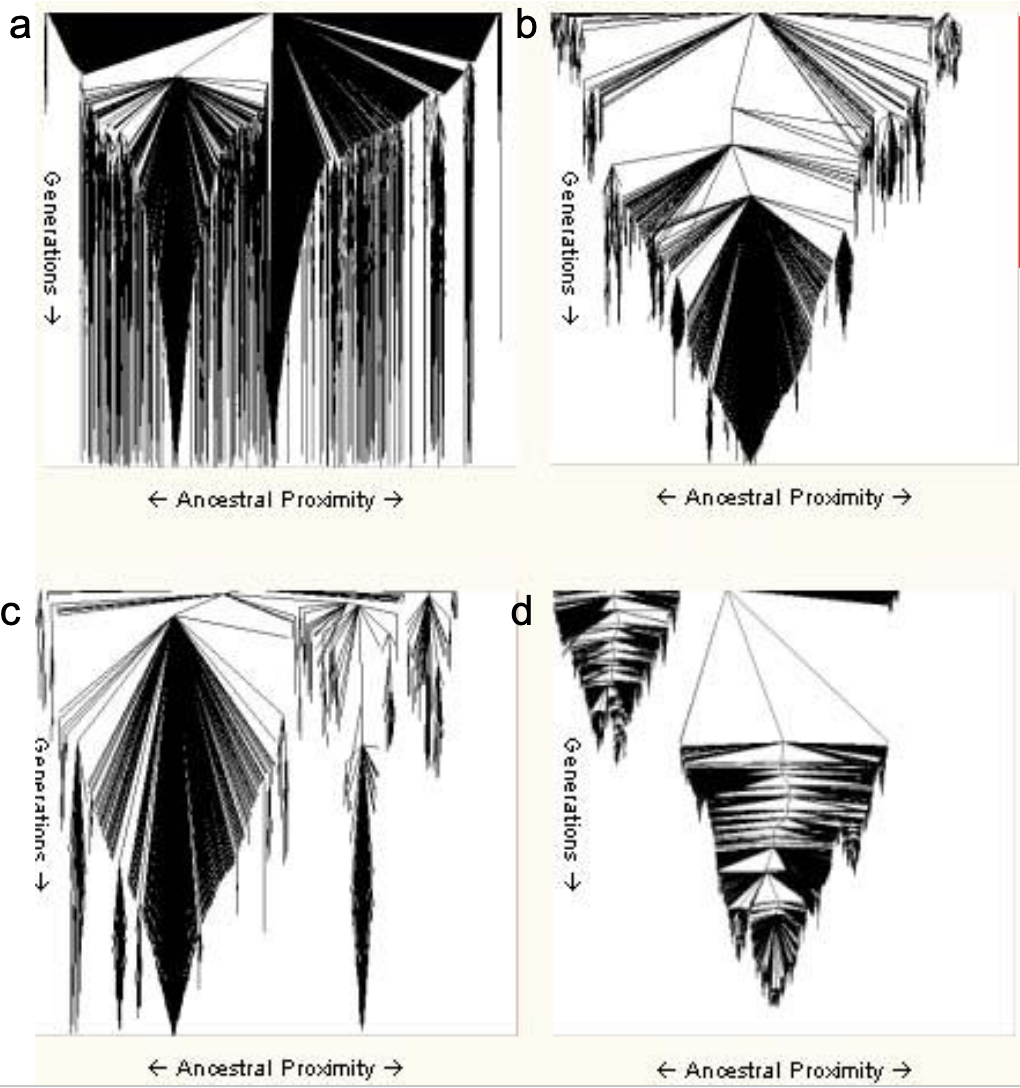
We can see macro evolutionary events
Macro Evolutionary Events
- Divergence
- Convergence
- Emergence of species
- Extinction
In Reality
Model performed well in real life on a carpet surface, with some interesting design choices made by the evolutionary algorithm.
The success of evolutionary generated hardware via 3d Printing got many interested in how 3d printing could allow for