In a Biological sense, a neural circuit is a local cluster of Neurons closely connected via Synapses that carry out a specific function when activated. We like to think of these microassemblies as the higher level abstraction building blocks for complex cognitive functions, and even simple things like reflexes.
Beyond the classic structures of a Neuron ( Dendrites, Soma, Axons, and Synapses ), we also now can consider the more complex variations. Namely for synapses we have:
- Excitatory: Increase the likelihood of the postsynaptic neuron firing.
- Inhibitory: Decrease the likelihood of the postsynaptic neuron firing.
We also have Glial Cells, which provide structural support, insulation (myelin), and nutrients to neurons. They also play a role in synaptic transmission and circuit plasticity.
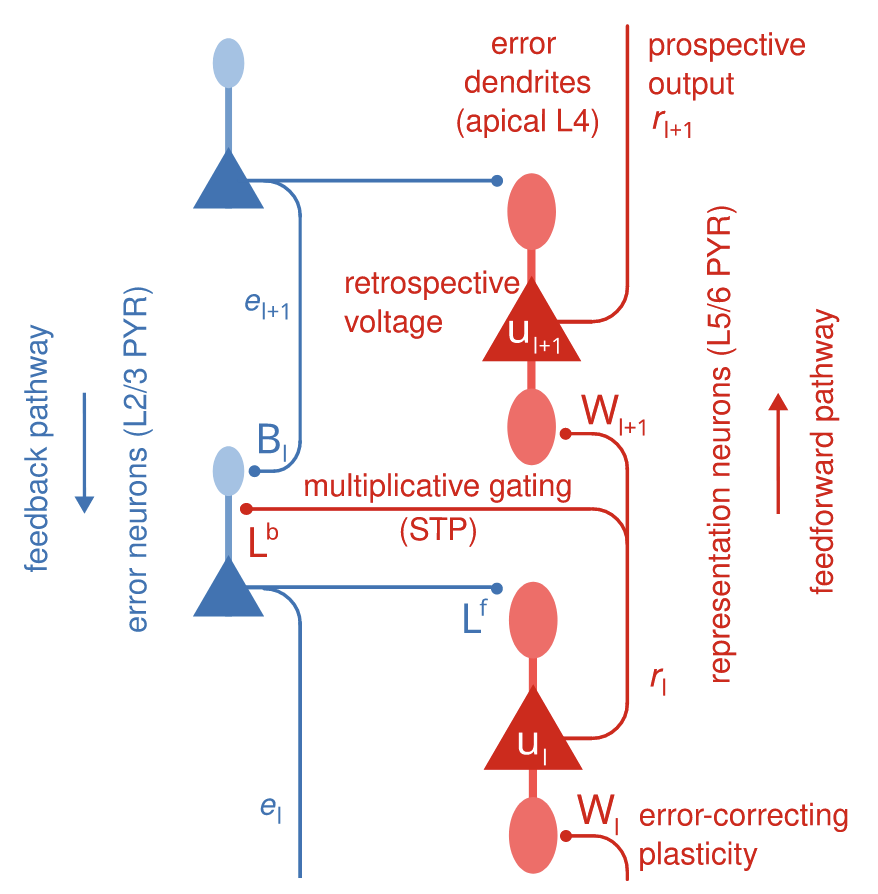
This figure is a theoretical microcircuit from paper ellenbergerBackpropagationSpaceTime2025b [@ellenbergerBackpropagationSpaceTime2025b]
Common Neural Circuits
These tend to get quite specific for theoretical modeling purposes and oftentimes may have no relation to their biological counterparts, but there are some that hold ground in both domains.
Cortical Columns
These are vertical structures in the cerebral cortex that consist of a group of neurons that work together to process specific types of information. They are thought to be the basic functional units of the cortex.
Some papers have garnered attention for the “1000 Brains Theory” of intelligence, which posits that the neocortex is made up of many such columns that work in parallel to process information.
Primitives from pathakBiomimeticModelCorticostriatal2024
Pathak, A., Brincat, S. L., Organtzidis, H., Strey, H. H., Senneff, S., Antzoulatos, E. G., Mujica-Parodi, L. R., Miller, E. K., & Granger, R. (2024). Biomimetic model of corticostriatal micro-assemblies discovers new neural code (p. 2023.11.06.565902). bioRxiv. https://doi.org/10.1101/2023.11.06.565902
Bibliography
- Pathak, A., Brincat, S. L., Organtzidis, H., Strey, H. H., Senneff, S., Antzoulatos, E. G., Mujica-Parodi, L. R., Miller, E. K., & Granger, R. (2024). Biomimetic Model of Corticostriatal Micro-Assemblies Discovers New Neural Code (p. 2023.11.06.565902). bioRxiv. https://doi.org/10.1101/2023.11.06.565902