(for the The Worldwide Air-Transportation Network website)
Chain Rule for Periodic Orbits
Chain rule for function composition:
When (composing a function with itself):
( is f composed with f, not f squared, see Linear Systems)
Applying the chain rule:
Application to Period-2 Orbits
If is a period-2 orbit of , then:
- and
- Equivalently: and
Applying the chain rule to find the derivative at each point:
Similarly:
Key observation: Both derivatives are equal:
This generalizes to any period- orbit. For a period-7 orbit, we compute:
Stability of Periodic Orbits
Stability is a collective property of the entire orbit. All points in a periodic orbit share the same stability:
for any periodic orbit .
In plain English, every point in a period- orbit has the same derivative when we apply , because they all cycle through the same sequence of local derivatives.
Definition: A periodic orbit is a sink (attracting) if
The orbit is a source (repelling) if the product has absolute value greater than 1.
Higher-Order Compositions
As you take higher compositions (), the pattern continues:
For , the fixed points include:
- All original fixed points of
- All period-2 orbits (if is even, or any multiple of 2)
- All period-3 orbits (if is a multiple of 3)
- Generally, all period- orbits where divides
Example: The graph of will intersect at points corresponding to:
- Period-1 orbits (original fixed points)
- Period-2 orbits ()
- Period-3 orbits ()
- Period-6 orbits
Each higher composition reveals more structure, turning periodic orbits into fixed points that can be analyzed using the chain rule.
Cobweb Plot Generator
Used claude to generate a little tool, mess around with parameter values to see what happens
Try these parameter combinations:
r = 2.8, composition_order = 1: Converges to fixed pointr = 3.2, composition_order = 1: Period-2 orbit (oscillates)r = 3.2, composition_order = 2: Period-2 becomes fixed pointsr = 3.5, composition_order = 1: Period-4 orbitr = 4.0, composition_order = 1: Chaotic behavior
Logistic Map Bifurcations
We talked about this on day 1, but we didnt discuss the bifurcation diagram in detail.
Have a look at the interactive code block in the Logistic Map note, it should look something like:
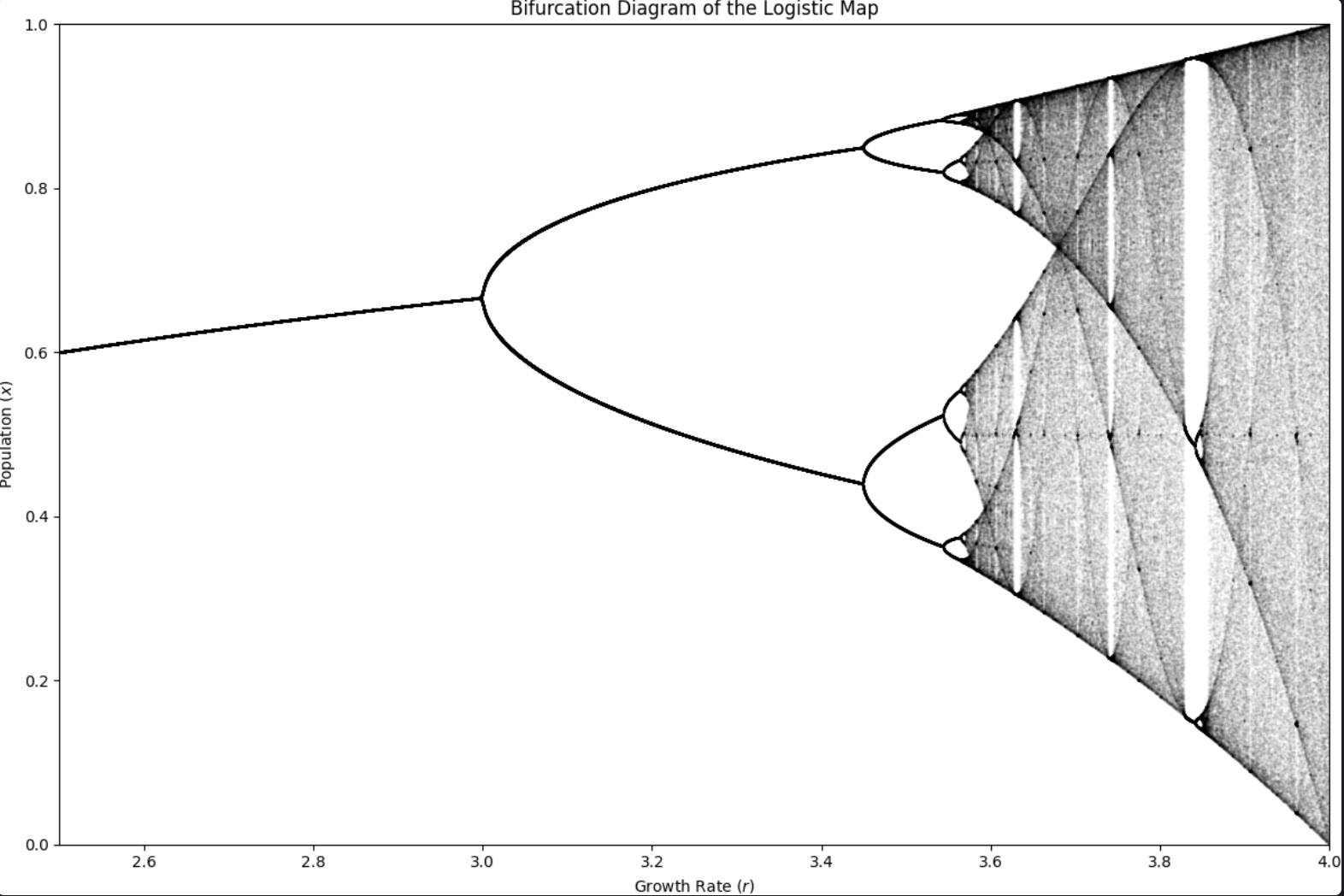
Why does this happen? It relates to the stability of fixed points and periodic orbits as we vary the parameter .
Each time a fixed point becomes unstable (derivative magnitude exceeds 1), a new periodic orbit emerges, leading to the bifurcation structure we see.
It is graphed by iterating the logistic map for many values of and plotting the long-term behavior of .
Back To Periodic Orbit Math
has a periodic orbit for every integer, all are sources. In fact, has fixed points.
Because each of these fixed points is a source, the periodic orbits of are all sources as well.