Problem 1
Question
Show that if is in a forward limit set, say , then the entire orbit is in .
want forward-invariance of . recall the definition:
assume continuous (standard).
there existxs a subsequence with . fix and apply to both sides. continuity of yeilds
let . then and , so by definition.
arbitrary so .
basically just “shift the index by ” method: tail of a tail is still a tail, thus continuity passes the limit through .
Answer
along . continuity gives , and , so for every . -limit sets are forward-invariant.
Problem 2
Question
(a) Show that the logistic map , for , has a chaotic set which is not a chaotic attractor.
(b) Show that the Horseshoe Map (described in Chapter 5) contains a chaotic set.
A
peak , so a middle interval gets ejected from on the first iterate. solving :
once a point lands in it leaves for good. define
is the set of orbits that stay bounded. each is a finite union of open intervals, is open dense, so is closed nowhere-dense. removing a middle gap and recursing yieldxs the standard Cantor construction, so is a Cantor Set, -invariant.
for , uniformly on , so is conjugate to the full one-sided 2-shift . that gives:
- dense periodic orbits in (periodic sequences are dense in )
- a dense orbit in (concatenate all finite words)
- sensitive dependence ()
is a chaotic set.
not an attractor: every is in some and escapes to , so the basin has empty interior. chaotic repeller, not attractor.
B
Smale horseshoe on the unit square: contract horizontally by , stretch vertically by , fold so is two disjoint horizontal strips . backward image is two vertical strips .
invariant set
at each iterate forward we keep two strips out of one (cantor in vert direction); each iterate backward halves the horizontal direction. so , product of two Cantor sets.
itinerary map ,
(equivalently via the symmetric setup) is a homeomorphism conjugating to the two-sided shift . semi known conjucgacy
shift on has dense periodic orbits, a dense orbit, sensitive dependence. conjugacy carries all three accross to . positive Lyapunov exponent comes for free from the vertical stretch: .
so is a chaotic invariant set inside the horseshoe.
Answer
(a) is a Cantor set, conjugate to the 2-shift, hence chaotic. all escape to , so the basin has empty interior - not an attractor. (b) , conjugated to the two-sided 2-shift via itineraries. shift dynamics is chaotic (dense periodics, dense orbit, sensitivity), conjugacy transfers it to .
Problem 3
Question
For the piecewise linear maps shown in (A) Figure 6.10, (B) 6.13, and (C) 6.14, find all periods for which there are periodic points.
use the transition graphs. for these Markov piecewise-linear maps, a closed path of length gives a point with . if the path is not a repeated shorter word, the point has exact period .
A
graph has arrows
there is a loop at , so period occurs. for any , take the closed path
with arrows. the corresponding word contains exactly one , so it cant be a repetition of a shorter word.
so Figure 6.10 has periodic points of every period.
B
the graph splits into two invariant components:
inside each component both intervals map across both intervals; in particular there are self-loops and arrows both ways. the self-loops give fixed points. for , for example,
is a primitive closed path of length . same story in the component.
so Figure 6.13 also has periodic points of every period.
C
the graph has arrows
so away from the boundary fixed point, every orbit alternates between and . therefore every closed path in the transition graph has even length.
all even periods occur. for , use the primitive closed path
of length (for , just ).
there is also a fixed point: the decreasing branch crosses the diagonal at , and .
so Figure 6.14 has period and all even periods, but no odd periods greater than .
Answer
(A) all periods .
(B) all periods .
(C) periods , i.e. and every even period, with no odd periods larger than .
Problem 4
Question
Let
and find all forward limit sets, attractors, and basins for each attractor. What is the basin boundary, and where do these points go under iteration?
write the map as
the coordinates decouple, and immediately
so everything is decided by the 1D map .
fixed points solve
obvious solutions are . there are no others: for ,
so on , increases once, then decreases forever; since , the only positive zero is . oddness gives the negative zero .
sign picture uields:
so if , the -orbit is monotone toward . if , toward . if , it stays at .
therefore the forward limit sets are exactly
now check stability:
at the eigenvalues are and , both less than in modulus. so and are attracting fixed points (sinks), constitent with the sign picture above. their basins are
at the eigenvalues are and , so the origin is a saddle, not an attractor. its stable set is only the -axis.
the basin boundary is the common boundary of the two half-plane basins:
points on this boundary stay on it forever:
Answer
forward limit sets: for , for , and for . the attractors are the two sinks and , with basins and . their common basin boundary is the -axis; boundary points satisfy and converge to the saddle .
Problem 5
Question
Let . Use matlab to answer the following two questions. Turn in your code with your answers.
(a) Choose a subinterval of length in the parameter which appears to contain only chaotic attractors (for example, an interval just shy of in Figure 6.3(a)). Magnify the region until a periodic window is located and find the smallest period among the orbits in the window.
(b) Choose a point on the attractor of for . Find this point by taking the th point of a trajectory in the basin. Choose another point in the basin and let be the minimum distance between and the first iterates of . Plot vs . Does as ? Can you quantify the rate at which it goes to zero? In other words, what is the function such that ? Suggest a potential mechanism for this relationship.
Suggestions:
- Only plot the point if and are distinct from each other, i.e. if the minimum distance has changed
- Make your plot axes logarithmic and use dots rather than lines, e.g.
loglog(n,m,'k.')- Do this for many different points , e.g. of them, to get a statistical sample of the typical behavior
- As you estimate for , do at least iterates
used python instead of matlab.
A
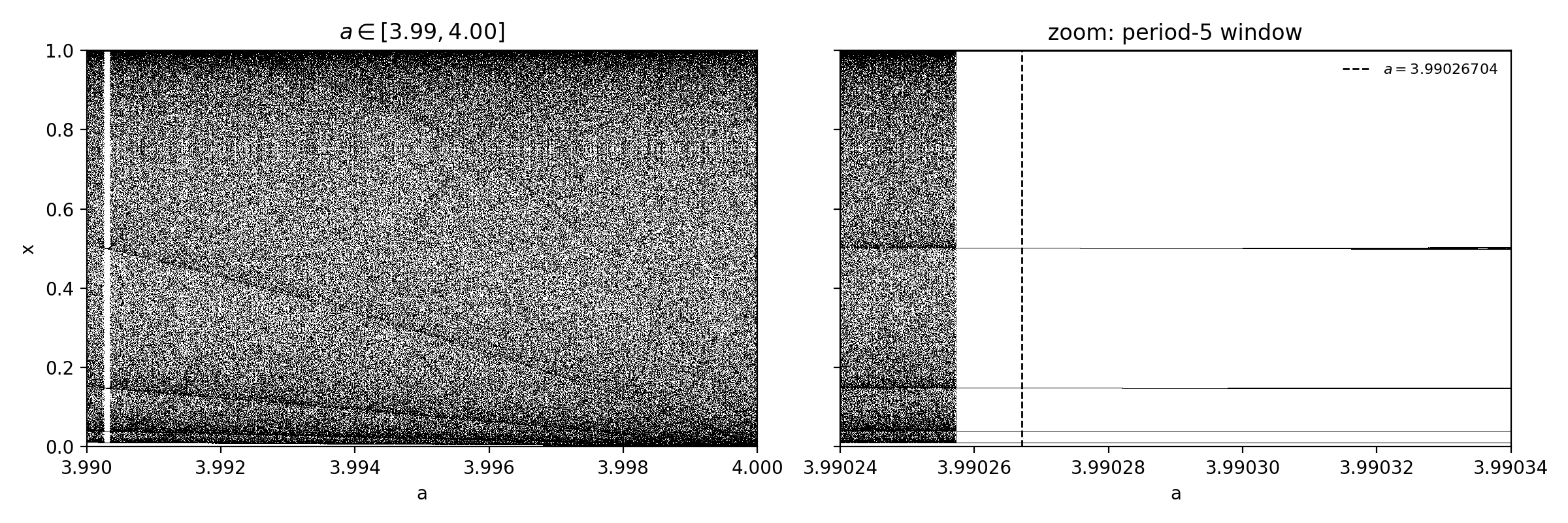
picked the length 0.01 interval
at normal resolution it looks chaotic basically everywhere. zooming into
reveals a small stable periodic window. at
orbit repeats with period after burn-in. the detected cycle is approximately
so the smallest period in this window is .
B
for , taking the th point of the trajectory starting at gave
random starting points in , iterated each for , tracking
fitting the median accross the orbits for gave
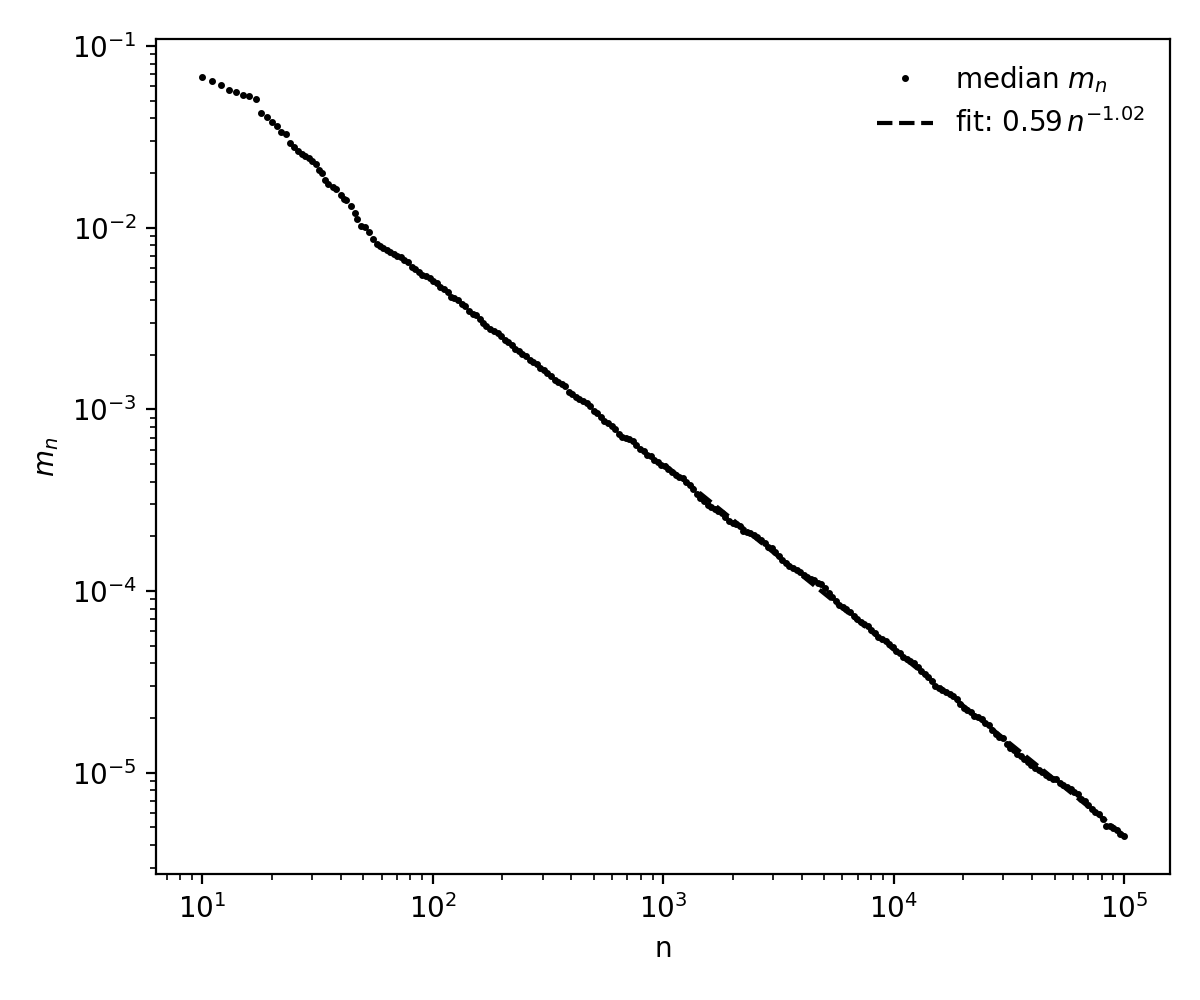
mechanism: after the transient, the chaotic orbit behaves roughly like samples from the invariant density on the attractor. if the density near is , then the chance that one iterate lands within distance of is about . after roughly independent tries, the nearest hit should satisfy
so . matchexs the standard recurrence / nearest-neighbor extreme value statistics for a mixing chaotic map.
Answer
(a) On the interval , zooming near reveals a stable period- window. the smallest period in that window is .
(b) For , using and random initial points, the closest-return distance decreases like , essentially . happens because a chaotic orbit samples invariant measure, so nearest hit to a f.p. among samples is typically order .