Question 1: Challenge 5 Step 1
Question
Assume that differs from by less than or equal to in each coordinate. In Figure 5.20 we draw a rectangle centered at with dimensions in the horizontal direction and in the vertical direction. Assume that the rectangle lies near the bottom left of the unit square, nowhere near the line , so that it is not chopped in two by the map. Then its image is the rectangle shown; the center of the rectangle is of course .
Show that the image of the rectangle is guaranteed to “map across” the original rectangle. Explain why there is a fixed point of in the overlapping region, within of .
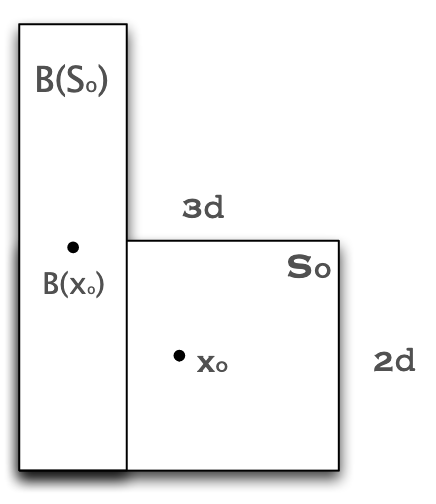
skinny baker lower half : . far from is affine on with const . image is rect centered at , thin/tall vs short/wide .
set and with .
mapping accross: extents horiz , horiz .
west: (since ), east: (since )
sits horiz inside .
extents: vert , vert . south: (as ), north: (as )
vert extent containes .
thin vert column sits inside horiz band of , overshooting top/bottom. that’s ‘mapping accross’!
FP: affine, solve with constants from . yieldxs unique FP :
dist to : , . both (sup norm ).
check overlap :
- : , ✓
- : , ✓
horiz contraction (1/3) forces convergence to vert line, vert expansion (2) gives repelling horiz line. intersecion is the FP; “maps accross” geometry guarantees it’s inside.
Answer
makes a rect centered at . horiz containment; vert overshoot. unique FP in within of .
Question 2: Challenge 5 Step 2
Question
Now suppose our computer makes mistakes in evaluating of size at most , and it tells us that and are equal to within . Prove that has a fixed point within of .
reported value. bounds in sup norm of error: nad reported equality:
triangle inequality:
so true within of . from p1: there existxs true FP with
Answer
triangle inequality gives . p1 with ensures FP within .
Question 3: Challenge 5 Step 3
Question
Prove Theorem 5.19. Let denote the Skinny Baker Map and let . Assume that there is a set of points such that each coordinate of and differ by less than for . Then there is a periodic orbit such that for .
pseudo-orbit hypothesis: (mod ). draw rects at each .
lies accross
same as p1 but sequence. avoids affine on with . is centered at .
let with : horiz is width , center within of , edges ‘s horiz span. vert is height , center within of , overshoots ‘s vert span .
‘mapping accross’ satisfied for all .
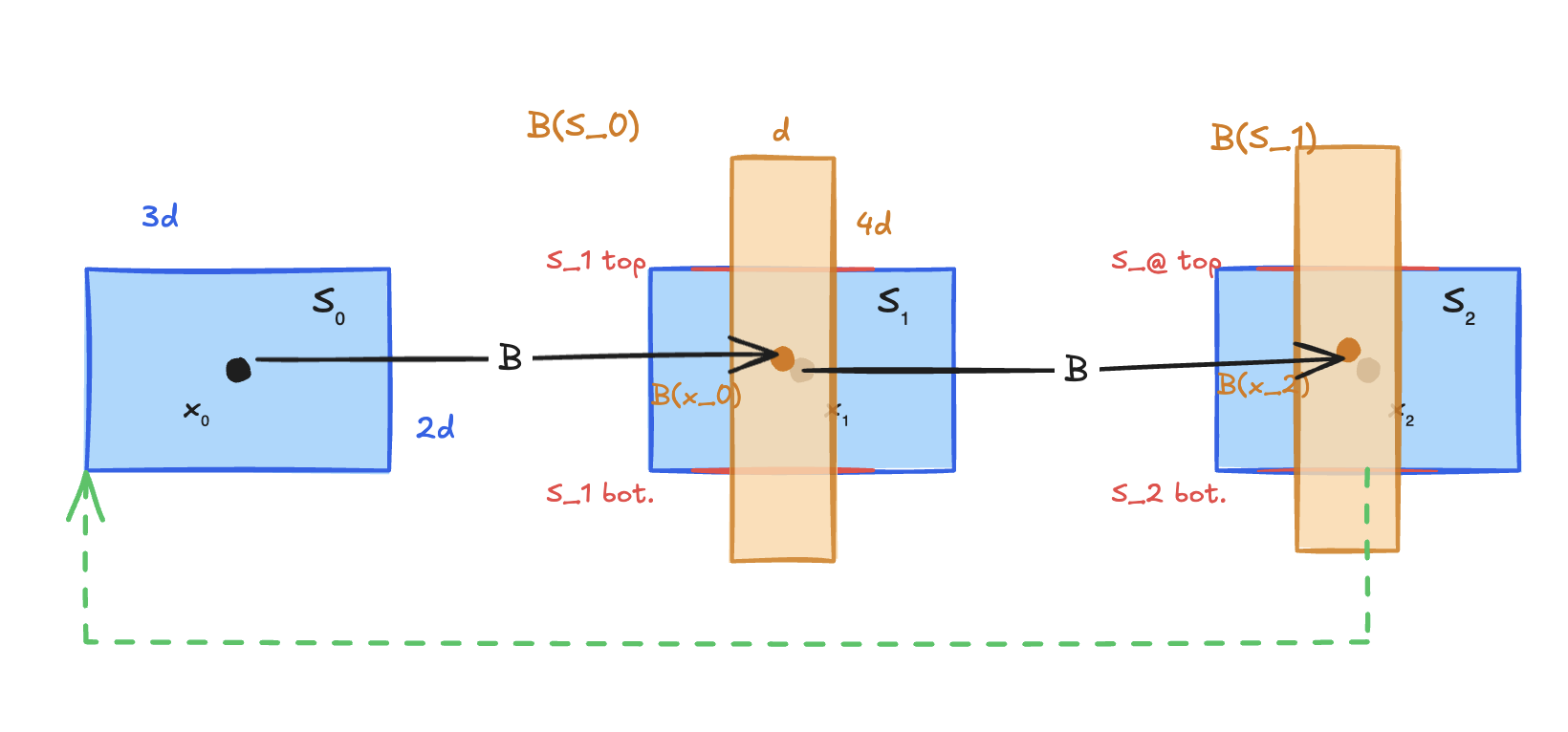
applying corollary 5.13 yields cyclic chain with crossing implies periodic orbit .
Gram Schmidt / horseshoe-like crossings trap periodic orbit. implies:
shadowing bound constitent with theory.
Answer
rects at . p1 geometry shows crossing . corollary 5.13 on cyclic chain yieldxs true periodic orbit , thus .
diagram attempt below was made in excalidraw. it may be on another page.
Question 4: Challenge 5 Step 4
Question
Let be a continuous map, and assume that there is a set of rectangles such that lies across for , each with the same orientation. Prove that there is a point such that lies in the rectangle for all . By the way, does have to be finite?
same orientation for . crossing means inside horiz and overshoots vert relative to .
nested preimages
. want to show .
claim: contains horiz sub-strip of .
induction: is strip. assume contains strip . spans horiz. crossing means overshoots vert while staying inside horiz. preimage of crossing column is sub-strip via continuity + IVT. call it .
finite vs infinite
for finite , pick any .
for infinite , nested compact nonempty sets. Cantor intersection . any works for all .
shadowing for pseudo-orbits of hyperbolic maps!
Answer
contains horiz-spanning strip by induction (preimage of crossing column is sub-strip via IVT). existxs for finite . infinite case via Cantor’s intersection theorem on nested compact .
Question 5: Challenge 5 Step 7
Question
Assume that a plot of length one million iterates of the cat map is made on a computer screen, and that the computer is capable of calculating an iteration of the cat map accurately within . Do you believe that the dots plotted represent a true orbit of the map (to within the pixels of the screen)?
yes! shadowing theorem works here.
cat map . .
. uniformly hyperbolic, .
naive error propagation: - huge! million-dot orbit is NOT forward orbit of its initial point.
real question: does a DIFFERENT true orbit stay close? yes , as cat map uniformly hyperbolic, so -pseudo-orbit is shadowed by true orbit .
shadowing dist .
pixels wide. shadowing dist is smaller. true orbit and pseudo-orbit fall in same pixel every step. dots faithfully represent true orbit at screen resolution.
requires hyperbolicity! fails for generic non-hyperbolic maps.
Answer
yeah. cat map uniformly hyperbolic (), so -pseudo-orbit is shadowed by genuine orbit within (generalized p4). screen pixels , so pseudo-orbit and true orbit look orthonganaly identical.