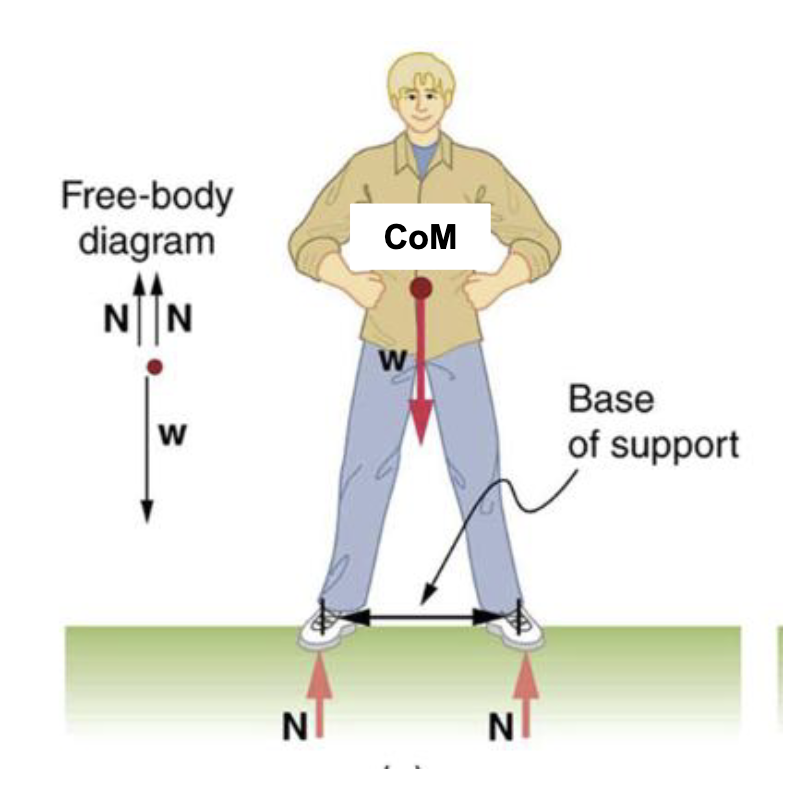
- Center of mass (CoM): Location of the whole body mass center. (a.k.a., “center of gravity”)
- Center of pressure (CoP): Location of the net force perpendicular to gravity (for one foot or both)
- Base of support (BoS): Range of possible locations of the CoP in a static posture.
Static balance: the abiltiy to keep the Center of Mass within the Base of Support
What happens when the Center of Mass exceeds the Base of Support?
Dynamic balance: the ability to keep the Center of Mass within the Base of Support over multiple gait cycles.
Why Balance is a Complex Processo
- It requires sensory information, both instrinsic via body and extrinsic via environment info
- proprioception ( body pos )
- mechanoreception ( pressure )
- visual
- vestibular ( ears )
- sensory integration and formation of a motor plan
- brain, cortical control
- Spinal Cord, sub cortical control
- execution of motor plan
- neuromusculoskeletal ssytem
- young people dont tend to use a lot of concious cortical control, very subconcious, whereas for older people is a much more concious process.
Ways to Balance
- ankle strategy
- modulate your center of pressure within the foot/base of support
- hip strategy
- modulate center of mass if center of pressure is limited ( e.g., balance beam )
- arm motion has a similar effect
- stepping
- when center of pressure exceeds base of support
- additional center of mass modulation