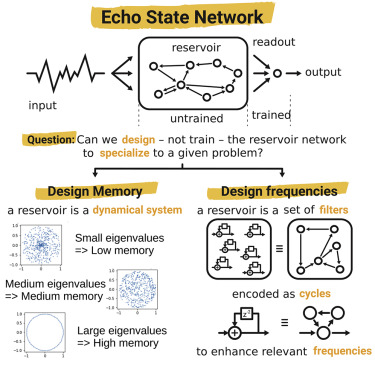
- one of the most common implementations of the Reservoir computing paradigm
- ESNs use large random fixed RNNs for its core hidden reservoir layer
- like any reservoir network, the trained parameters reside in the readout layer, only weights trained are those connecting to final output, usually using something like linear or Ridge Regression
- echo state property: reservoir must satisfy the ESP, meaning the internal dynamics must fade out past initial states and reliably echo the history of the input signal
- share conceptual roots with Liquid State Machines, as while they are frequently adapted into Spiking Neural Networks to model the precise event-based Temporal Dynamics of biological Neurons
- Brain Computer Interfaces use these a lot for decoders, as they are great for low latency real time processing as only the linear readout layer is trained
- Drosophila Connectome simulations that you see everywhere often use these.