Let be a simple closed curve and let be the region bounded by . We say has positive orientation if is traversed in the counterclockwise direction.
Positive Orientation
is always on your left as you traverse the curve
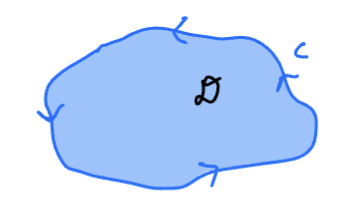
Negative Orientation
is always on your right as you traverse the curve
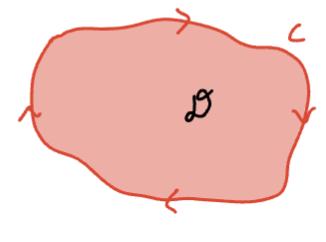
Abstract
Green's Theorem (named for George Green):
Let be a simply connected region whose boundary curve is a simple, closed, positively oriented curve. If and have continuous first-order partials on some open region containing , then:
This theorem says that under certain conditions, we can evaluate a line integral as a double integral.
Remarks
- To use this theorem correctly, note that must have positive orientation. If has negative orientation, we have to multiply our answer by :
- We can state the theorem more succinctly as:
- The notation "" means “boundary curve of ”. So, .
- is a closed curve, so we use the notation (recall this is called a circulation integral).
- If , the integrand says:
which is the form we used on the previous page.
Proving Green’s Theorem
We will prove this for the special case where is a simple region, meaning a region which is simultaneously Type I and Type II. We wish to show:
We will do this by showing:
The result will follow by linearity of the integral.
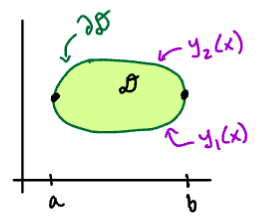
Let be a simple region with positively-oriented boundary curve . Consider the case where we view as a Type I region:
Sketch
as a Type I region
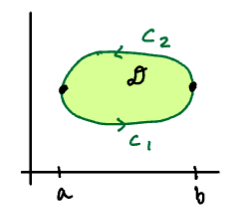
Sketch
decomposed into
We compute the first expression in (*) directly as:
( The “negation” trick will help us soon. ) We can parameterize and by:
(**) is then:
This is exactly what we wanted in (*). The other expression in (*) can be obtained by regarding as a Type II region.
Finding Area with Green’s Theorem
Recall that the area of region can be found by:
Green’s Theorem says that:
So, if we can find functions and satisfying , then we can “reverse” Green’s Theorem and find area by computing a line integral.
There are several ways to “force” :