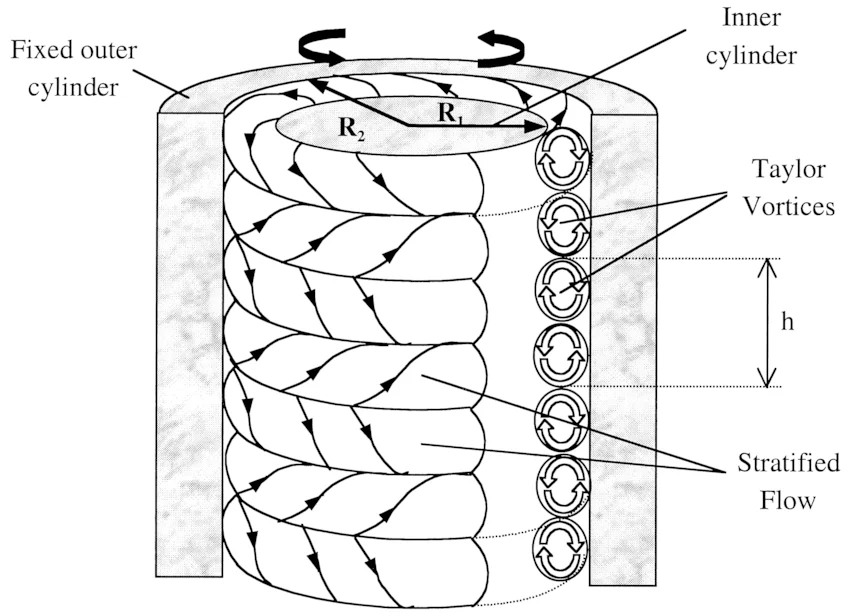
Fluid motion between two rotating concentric cylinders. Fundamental problem in fluid dynamics, setup usually has an inner cylinder of radius and outer cylinder of radius . Then you have the gap in between, usually liquid or a gas.
- As inner cylinder spins, the fluid is dragged along by friction (viscosity). The flow evolves through distinct stages as the rotation speed increases.
- Steady Laminar Couette Flow (Low Speed); at low speeds flow is smooth and stable, rotates as rigid rings with velocity increasing from zero at the ouer wall to to the cylinder speed at the inner wall
- velocity profile (roughly, depending on geometry)
- Taylor Instability (Moderate Speed); as rotation increases, centrifugal forces on the fluid partidles become stronger, fluid tries to fly outward, but viscous forces try to hold it to the rotating wall.
- at critical speed, centrifugal force overcomes stabilizing effect of viscosity and becomes unstable
- Wavy Vortex Flow (Higher Speed); if gap is closed and the rotation increases more, taylor vortices become unstable to some wave like perturbayions. rolls deform and wave around
- Turbulent Regime (High Speed); vortices break down compltety, flow becomes chaot ic and turbulent. heat transfer and mixing in this regime are significantly higher than in the laminar regimes
- Steady Laminar Couette Flow (Low Speed); at low speeds flow is smooth and stable, rotates as rigid rings with velocity increasing from zero at the ouer wall to to the cylinder speed at the inner wall
Onset of Chaos within this flow often characterized by Lorenz Attractor type equations.
Reynolds Number (): Measures the ratio of inertial forces to viscous forces.
(Where is rotation speed, is gap width, is kinematic viscosity.)
Taylor Number (): This is the specific stability parameter for Taylor-Couette flow. It measures the ratio of centrifugal forces to viscous forces in the gap.
The flow remains laminar below a critical Taylor Number (). Once , the instability sets in.