Note about Go-Back-N
Consistent with the course textbook definition, we assume that the Go-Back-N receiver does not buffer packets received out-of-order, but just discards them.
Problem 1 (24 points).
Question
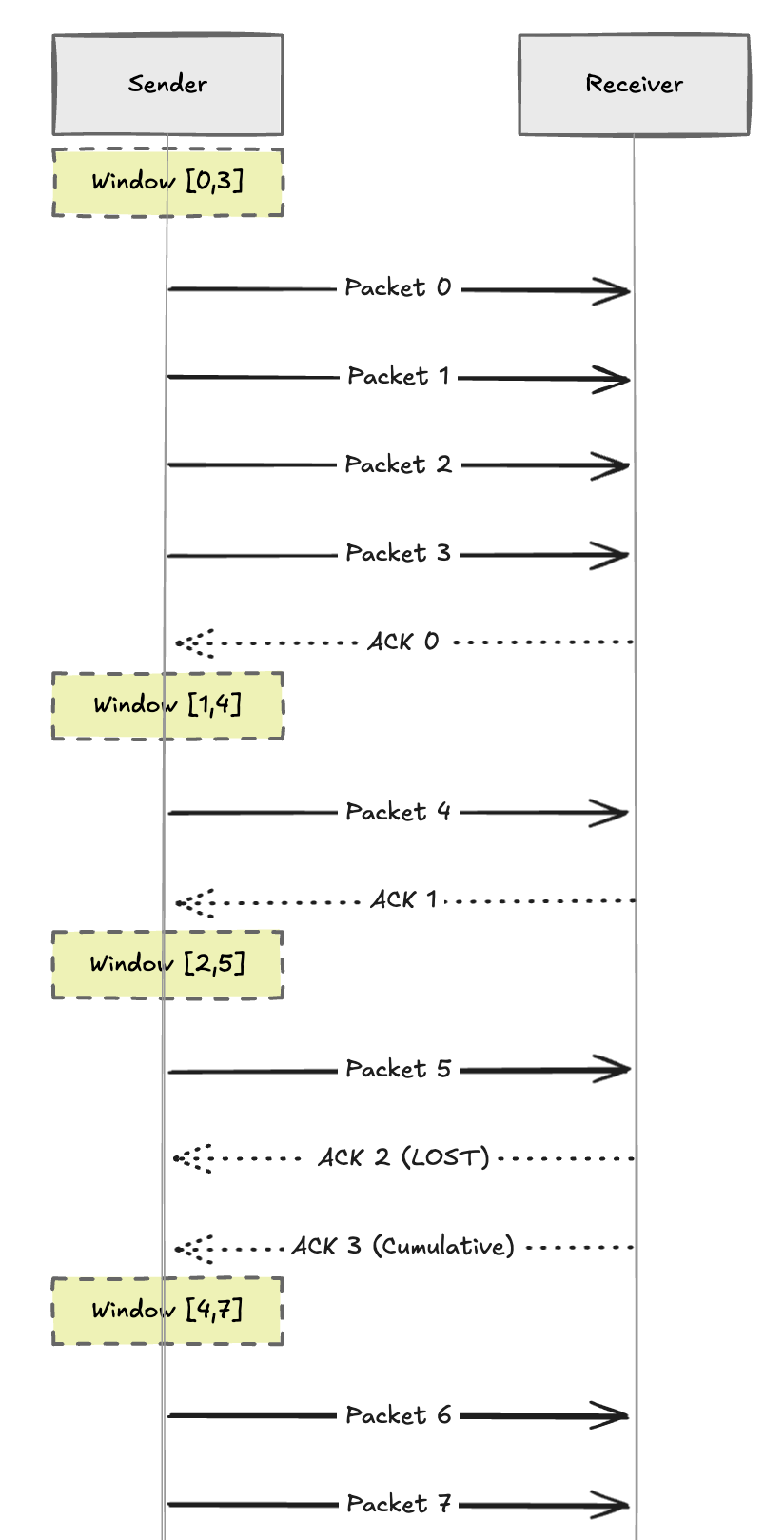
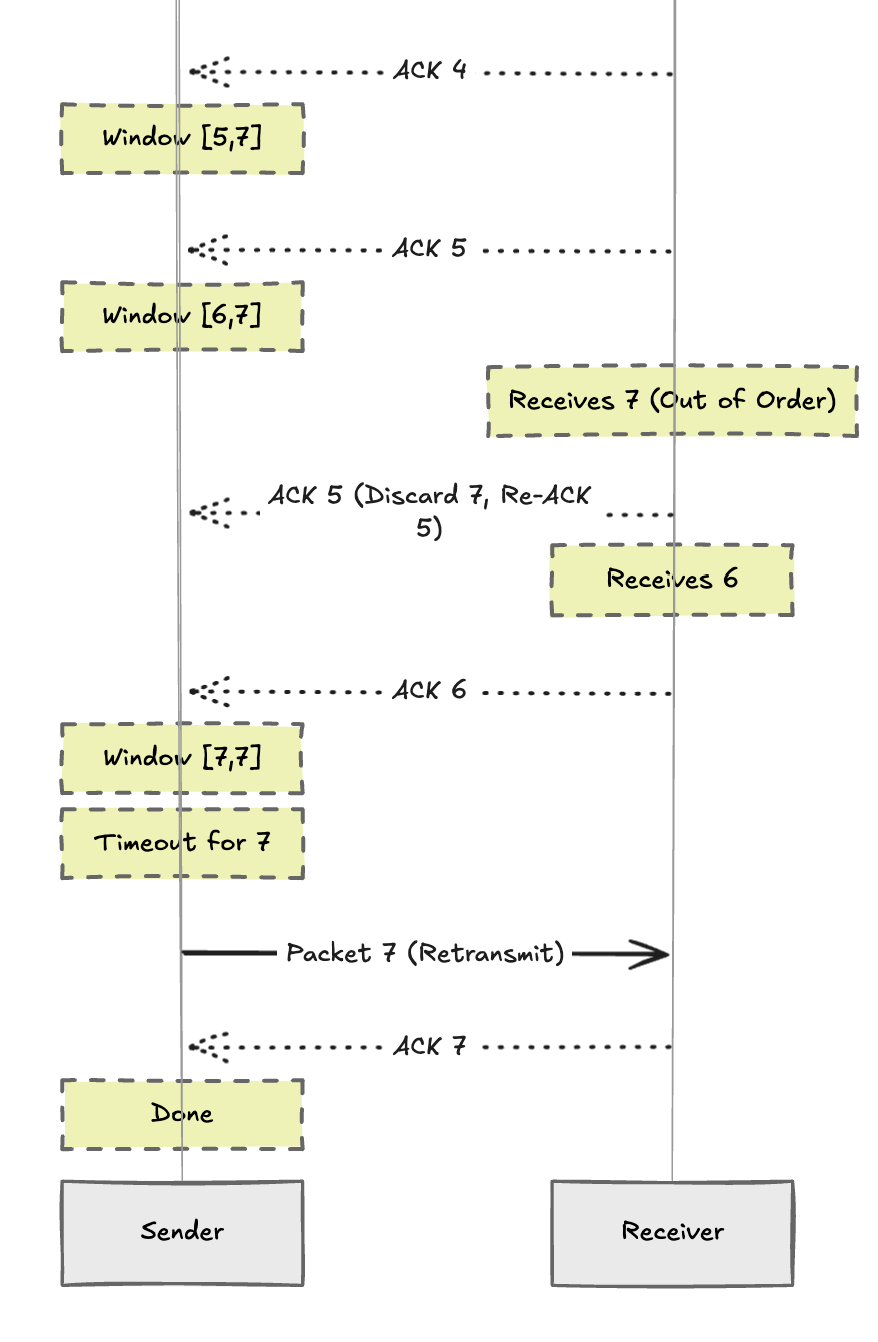
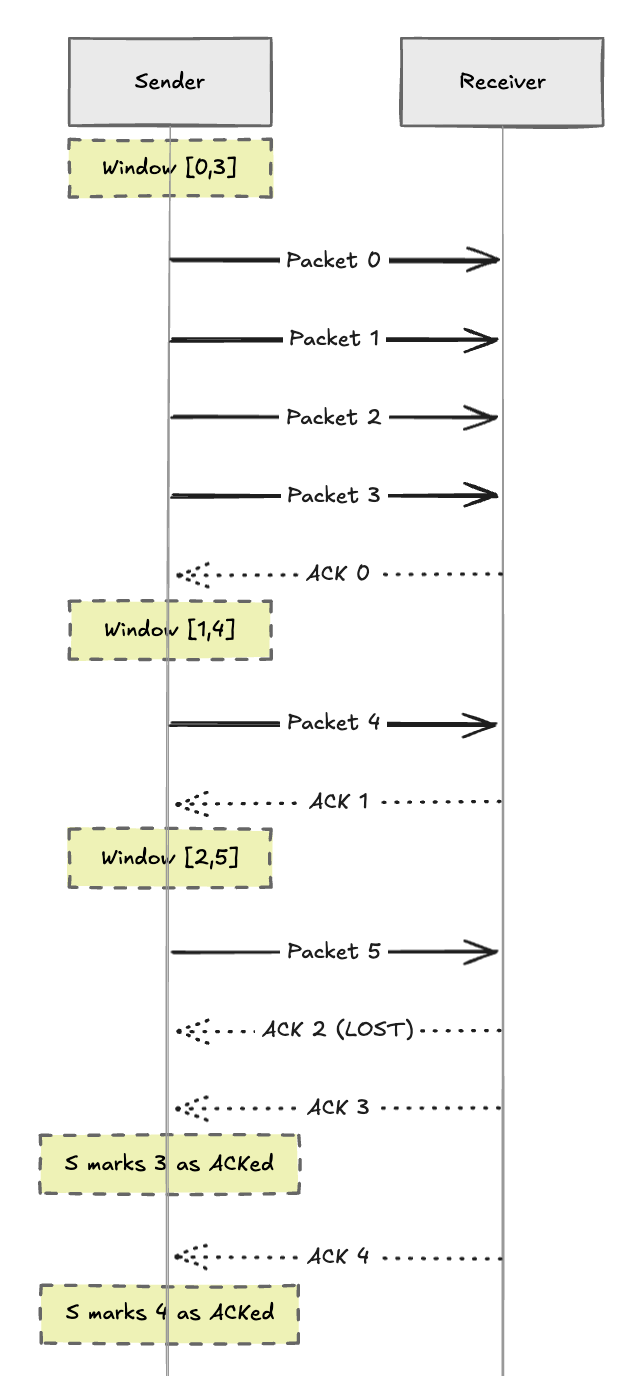
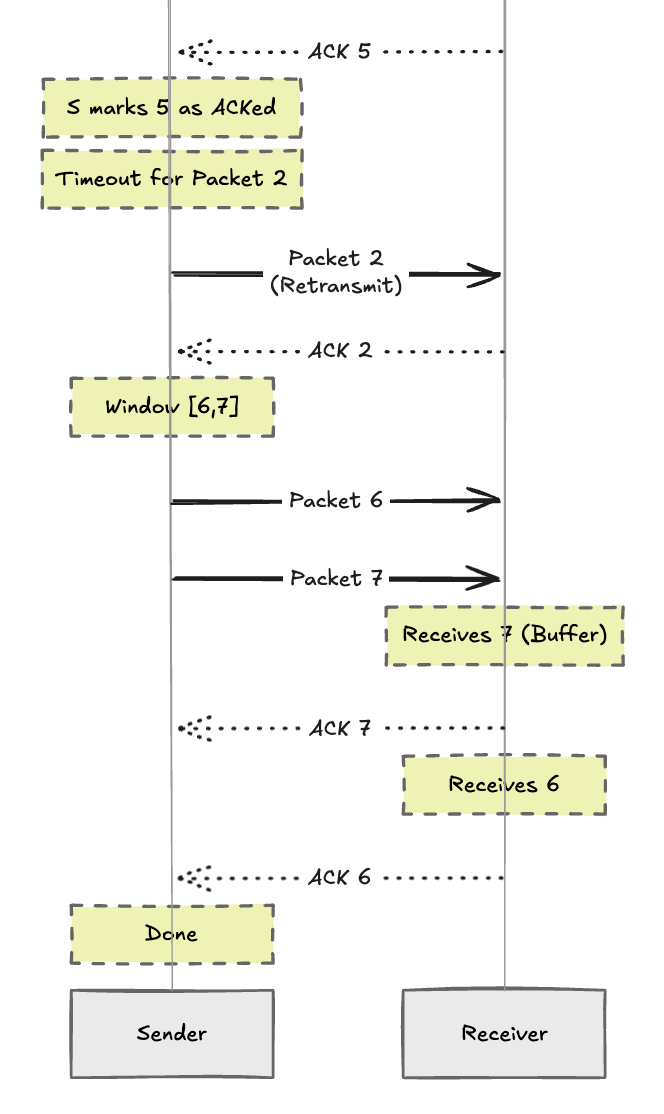
Consider the Go-Back-N and Selective Repeat protocols. Assume that 8 packets with sequence numbers 0-7 are to be sent, with a window size N=4. Using messaging diagrams in the style we’ve been using, show the sequence of exchanges that result for both Go-Back-N and selective repeat given all of the following assumptions:
- RTT does not change, and is less than the protocol timeout intervals.
- The transmission rate of packets is negligible.
- The first ack of packet 2 is lost.
- The first sends of packets 6 and 7 arrive out-of order.
Solution
Go-Back-N
we see cumalative acks, ACK 2 lost howevr ACK 3 arrives, thus sender slides window past 2. when 7 arrives before 6, receiver discards 7 and re ACKs 5.sender times out on 7 and retransmits.
Answer
warning diagram may be on another page
Selective Repeat
just individual acks, ACK 2 lost triggers a timeout for packet 2 only. out-of-order packets 6 and 7 are buffered at the receiver, so only packet 2 needs to be retransmitted.
Answer
warning diagram may be on another page
Question
Consider the Go-Back-N protocol with a window size N = 50. Suppose only 30 packets are to be sent with sequence numbers 0-29, and also assume the following:
- RTT does not change, and is less than the protocol timeout intervals.
- The transmission rate of packets is negligible.
- The first send of the packet with sequence number 9 is lost.
Now, answer the following:
a. How many packets will be resent? b. Imagine that the Fast Retransmit optimization has been added to the protocol with the addition of receiver-side buffering to support the optimization (as we’ve discussed in Active Learning 2, Topic 3.c). How many packets will be resent in this case?
Solution
Answer
a. packet 9 lost, thus receiver discards everything after (10-29) and sends dup ACK 8 for each. after sender timer expires, retransmits 9 - 29. total of 21 packets
b. given fast retransmit and receiver buffering, receiver stores 10-29, 3 dup ACKs for 8 trigger early retransmit of only packet 9. after 9 arrives, receiver delivers 9-29 in order and ACKs 29. total of 1 packet
Problem 3 (20 points).
Question
Assume that in some TCP communication cwnd is currently at 80. For simpicity assume MSS = 1. Specify resulting values of cwnd and the slow-start threshold in each of the following scenarios:
a. A triple-duplicate ACK is detected using TCP Reno. b. A triple-duplicate ACK is detected using TCP Tahoe. c. A timeout is detected using TCP Reno. d. A timeout is detected using TCP Tahoe.
Solution
Answer
for all given cases, .
a. TCP Reno (3-dup ACK): fast recovery. , ( for the 3 dup-ACKd segments still in flight).
b. TCP Tahoe (3-dup ACK): no fast recovery, and treated same as timeout. , .
c. TCP Reno (timeout): resets to slow start , .
d. TCP Tahoe (timeout): , .
Problem 4 (36 points).
Question
Do the following problems in the textbook Chapter 3: P23 (10 points), P31 (12 points), P40(a-g) (14 points). Photos of these problems are included in the Brightspace posting for this assignment.
Solutions
P23
Answer
window size , sequence space (indices 0-3). showing receiver can accept a duplicate if :
- sender sends 0, 1, 2. receiver delivers and sends ACK 0, 1, 2. receiver window slides to [3, 0, 1].
- all ACKs (0, 1, 2) are lost.
- sender’s timer for 0 expires, retransmits packet 0.
- receiver sees 0 is in its current window [3, 0, 1], accepts it as new and delivers it again.
protocol failure. to prevent this, need .
P31
Answer
, , initial , .
Sample SampleRTT EstimatedRTT DevRTT TimeoutInterval - - 100.00 5.00 120.00 1 106 100.75 5.25 121.75 2 120 103.16 8.75 138.16 3 140 107.76 14.61 166.20 4 90 105.54 15.40 167.14 5 115 106.72 13.91 162.36
P40
Answer
a. slow start intervals: rounds [1, 6] and [17, 22].
b. congestion avoidance intervals: rounds [6, 16] and [22, 26].
c. loss at round 16: timeout. cwnd drops to 1, not half, triple-dup ACK in Reno would halve it.
d. loss at round 22: triple duplicate ACK. cwnd halves rather than resetting to 1.
e. initial ssthresh: 32. exponential growth switches to linear at round 6 when cwnd hits 32.
f. ssthresh at round 18: 21. loss at round 16 with cwnd=42, so .
g. ssthresh at round 24: 21. no new loss event, ssthresh unchanged.
h. 70th segment: rounds 1-6 send segments. round 7 has cwnd=33. 70th segment sent in round 7.
i. triple-dup ACK at round 26 with cwnd=25: , .