Problem 1
Question
Find a general formula for (area-contracting) skinny baker maps, where the strips have width instead of . Find the area contraction factor (per iteration) and the Lyapunov exponents.
same setup as hw 8 p4 but replace with ! map takes the unit square, cuts in half horizontally, then squishes each half into vertical strip(width , height ):
bottom half goes on left strip , top half on right strip . contracts by horizontally, stretches by vertically.
Jacobian same for both:
area contraction factor - . for the map to be area-contracting we need , i.e. . (the original skinny baker had , giving .)
Lyapunov exponents - Jacobian is constant + diagonal, so . the exponents read off directly:
(expanding, vertical), (contracting, horizontal since ).
sanity check - . product of Lyapunov numbers equals the Jacobian determinant, consistent with what we’ll show in problem 2.
Answer
on bottom half, on top half. area contracts by factorof per iteration ( required). Lyapunov exponents: , .
Problem 2
Question
Assume that the map on has constant Jacobian determinant, say for each . Explain why the product of all Lyapunov numbers is .
using chain rule, Jacobian of the -th iterate is:
determinants:
since everywhere.
now, for any matrix , the product of its singular values equals . the Lyapunov exponents are defined from the singular values of :
summing all exponents:
the Lyapunov numbers are , so:
Answer
by cchain rule. product of singular values = determinant, thus summing Lyapunov exponents yieldxs . exponentiating: .
Problem 3
Question
Following the discussion on page 200 of the text, write the result of the Gram-Schmidt orthogonalization procedure as an matrix equation , where the columns of are , the columns of are , and is an upper triangular matrix. Show that , so that . Explain why this implies that the ellipsoids and have equal -dimensional volume. Depending on your matrix algebra skills, you may want to start with the case .
are vectors after applying Jacobian/5.3, and the are orthogonalized vectors produced by Gram Schmitd/ 5.4. is the unit sphere.
First
Gram Schmidt / 5.4 yiellds:
rearranging to express ‘s in terms of ‘s:
set . in matrix form:
so with , upper triangular, 1s on diagonal. .
General
from 5.4/ Gram Schmitd defines:
rearranging each equation to isolate :
this is a linear combination of with coefficient 1 on . reading off columns: where
is upper triangular with all diagonal entries equal to 1. determinant of a triangular matrix is the product of diagonal entries:
therefore .
Equal Volume /
image of the unit sphere under matrix is an ellipsoid with volume , where is the volume of the unit -ball. ellipsoid is image after applying Jacobian, and is ellipsoid spanned by orthogonalized vectors. since :
so Gram Schmidt reshapes the ellipsoid to align axes orthonganaly but preserves volume, why QR works. we can orthogonalize at each step without losing volume information, no floating point blowup issues.
Answer
reusing 5.4 yielded with above diagonal, 1s on diagonal, 0s below. , so . ellipsoids and have equal volume.
Problem 4
Question
Plot the orbit of the two-dimensional Tinkerbell map
where , , , , with initial value . The orbit tends toward an oval-shaped quasiperiodic attractor. Find out what replaces the quasiperiodic attractor when the parameter is decreased or increased.
at default , orbit settles onto smooth invariant circle, quasiperiodic/never exactly repeating:
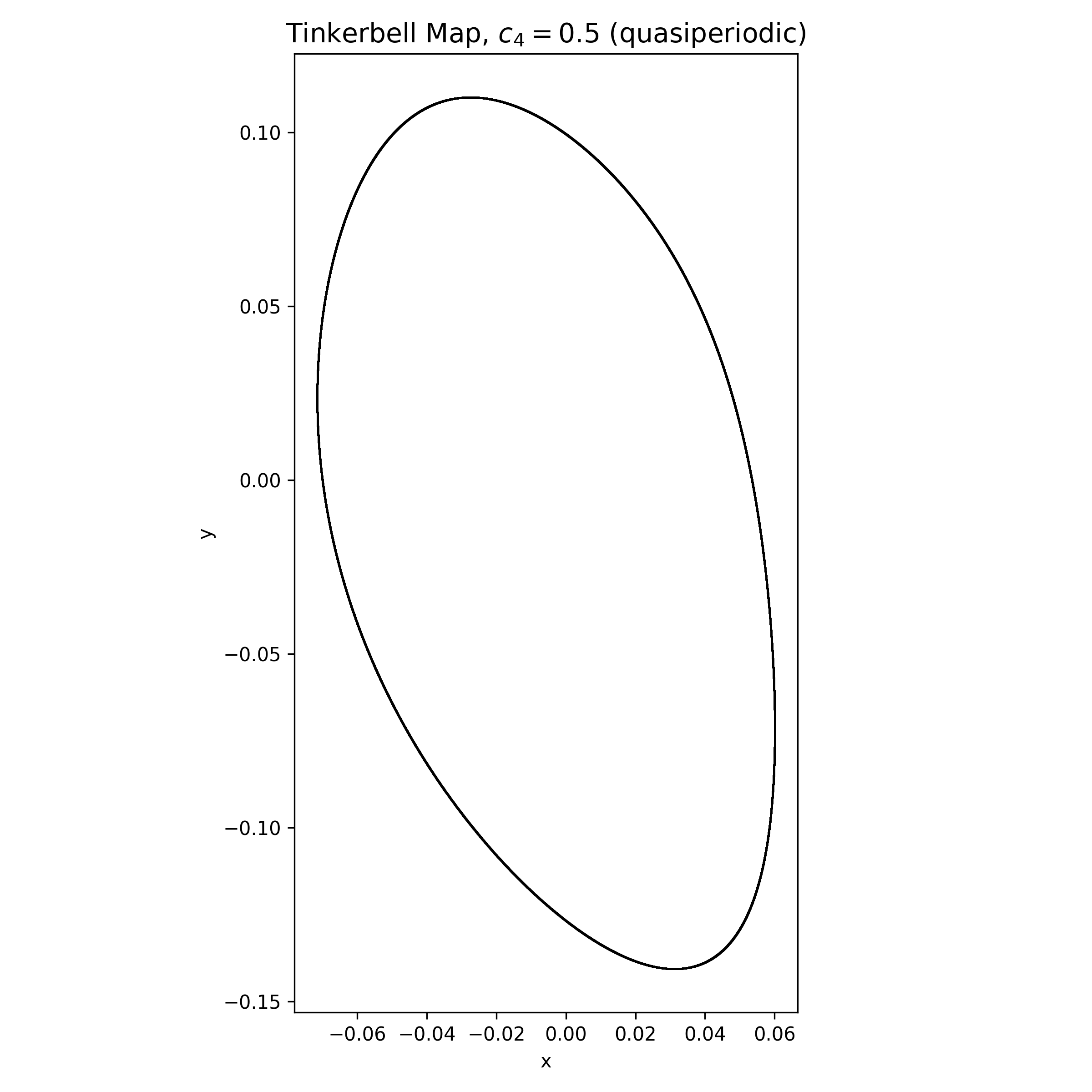
origin is always fixed point. Jacobian:
characteristic equation: , thus complex conjugate eigenvalues: .
set : .
- origin is a stable spiral (). orbit spirals into the fixed point. the invariant circle DNE
- eigenvalues cross the unit circle. invariant circle born.
- origin is unstable (). orbit settles onto invariant circle surrounding, yields smooth oval.
- invariant circle loses smoothness + breaks up into a chaotic attractor, orbit fills 2d region instead of a traced curve
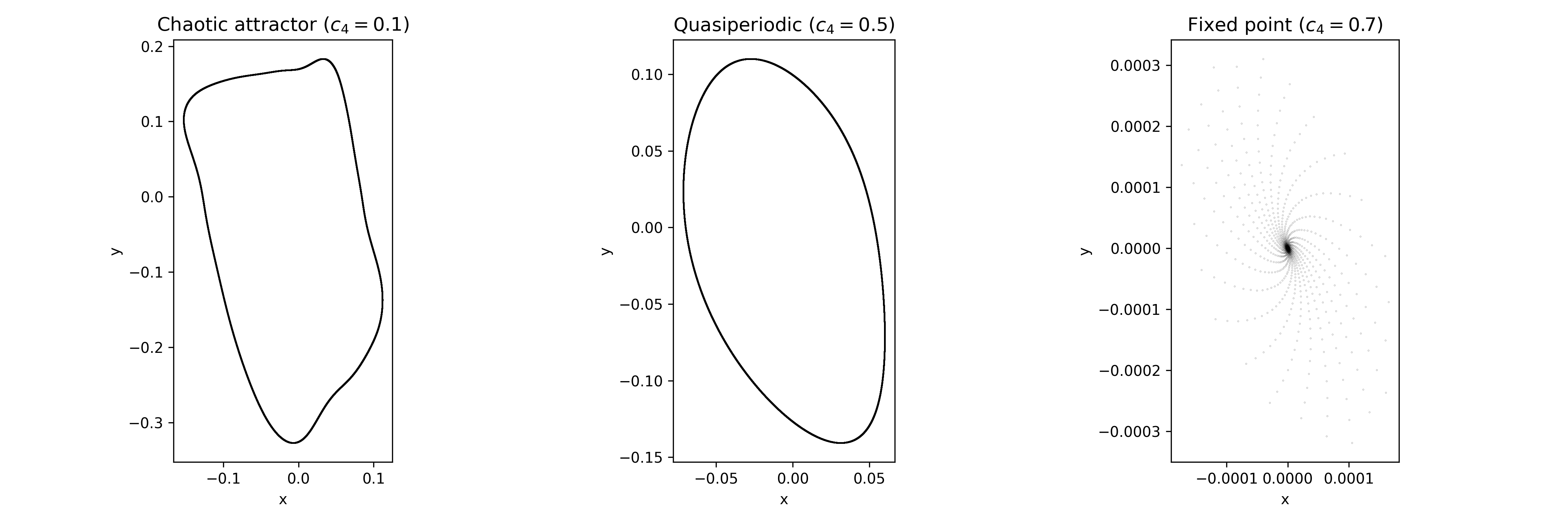
Answer
increasing - invariant circle shrinks and vanishes at , stable origin fixed point replaces it
decreasing - invariant circle grows, lose smoothness, becomes chaotic attractor
Code
Problem 5
Question
Write a program to measure Lyapunov exponents. Check the program by comparing your approximation for the Henon and Ikeda maps with what is given in the text on pages 201-202. Calculate the Lyapunov exponents of the Tinkerbell map quasiperiodic orbit from the previous exercise (one should be zero). Finally, change the first parameter of Tinkerbell to and repeat. Plot the orbit to see the graceful-looking chaotic attractor which gives the map its name. Turn in your code along with the LE estimates.
QR - for each iterate, apply Jacobian to orthonormal basis, Gram Schmidt orthogonalize, record before normalizing. after steps, -th Lyapunov exponent:
Henon (): (text: ), (text: ). Ikeda: (text: ), (text: ). both match to two decimal places.
Tinkerbell Quasiperiodic ,
as expected - on invariant circle, tangential dir shows no growth or shrinkage. reflects transverse contraction that keeps orbits on the circle.
making sure: . Tinkerbell Jacobian determinant is , which varies along the orbit but averages to , constitent.
Tinkerbell Chaotic ,
confirms chaos. attractor has signature looping, quite elegant!
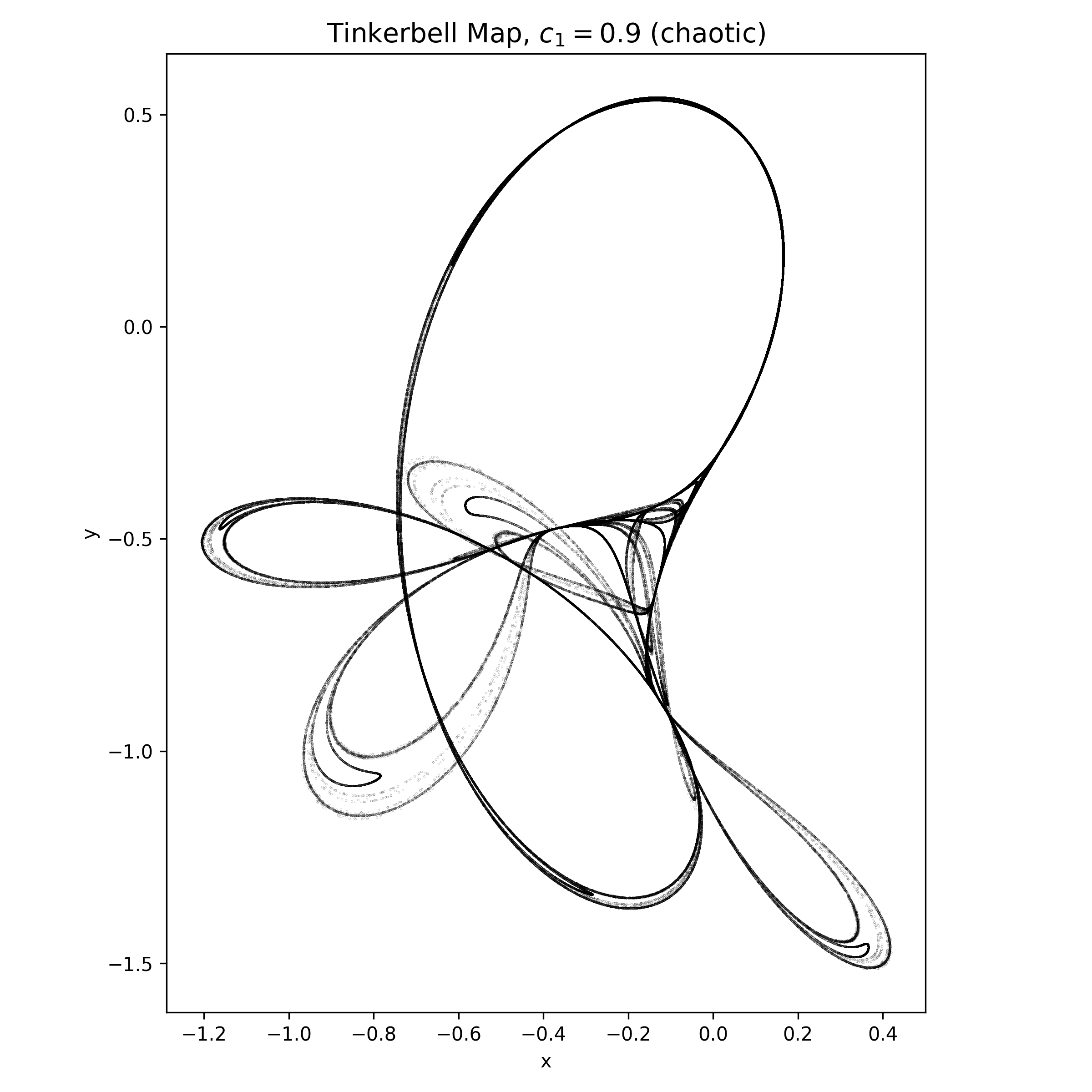
Answer
Gram Schmidt matches text vals for Henon (), Ikeda ()., Tinkerbell quasiperiodic: ,expected 1 zero. Tinkerbell chaotic (): chaos confirmed via positive exp.