Problem 1
Question
(a) Show that union of two countable sets is countable.
(b) Let be a countable collection of countable sets. Show that the union of the are countable.
A
must be bijection from A to and B to , we can simply zipper them
let and be countable. define by:
this will yield some
every element is in or , so it appears as some or , meaning hits it. is surjective, so is countable.
Answer
weave two enumerations odd/even switches. resulting map is surjective, so is countable.
B
enumerate each . arrange all elements in a grid:
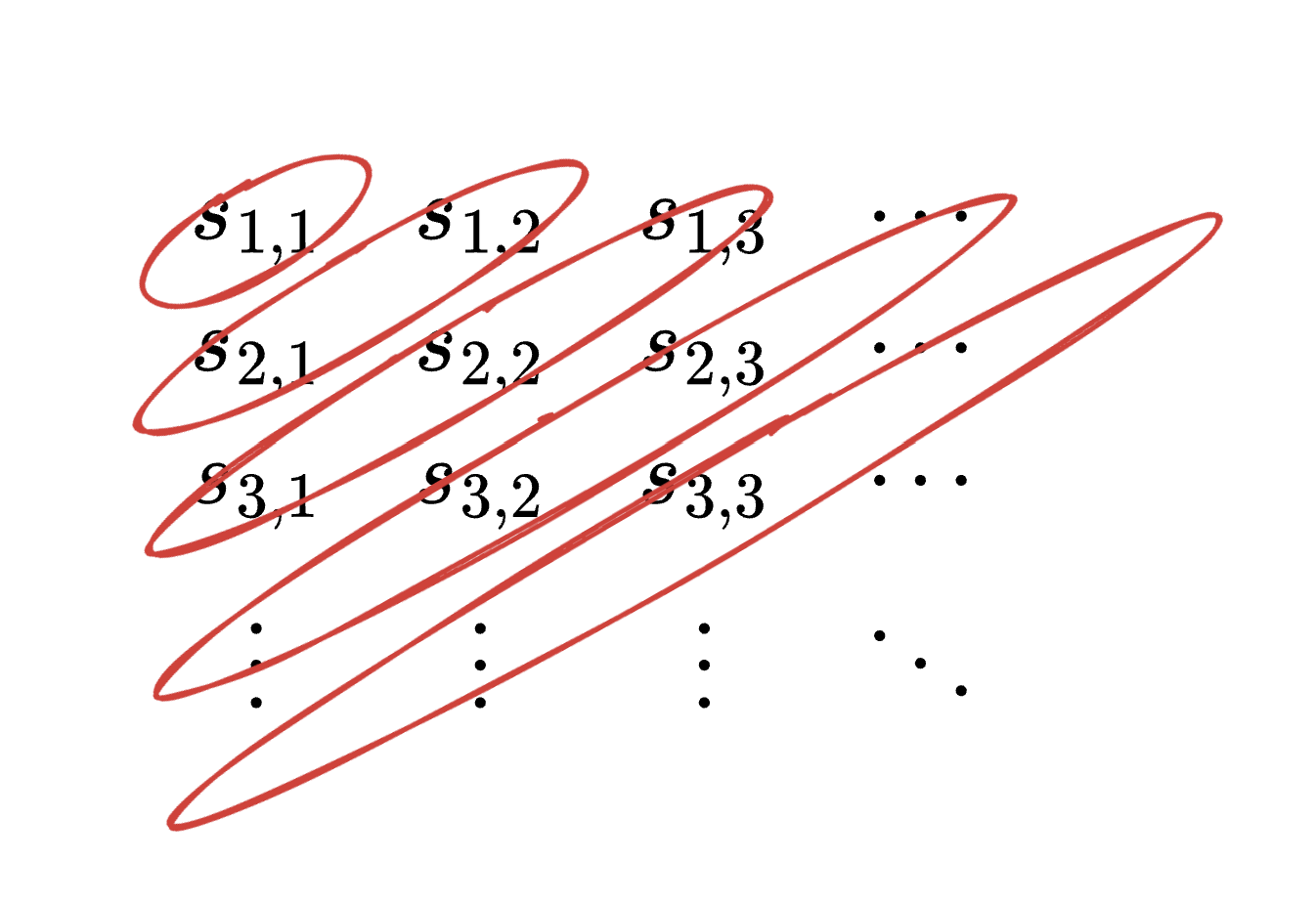
traverse by diagonals: first diagonal gives . second diagonal yields . -th diagonal gives .
Answer
lists every exactly once, also “distributes evenly”. I think this is a variation of Cantor’s diagonal argument, or whoever really came up with it.
Problem 2
Question
Characterize all members of the middle-thirds Cantor set in terms of ternary expansions. Include the
- left and
- right endpoints of intervals that have been removed,
- rationals that are not included already in (1) & (2), and
- irrationals.
Hint: Describe the ternary expansion of these four ways to make it into .
only if can be expanded in ternary s.t.: where .
construction: for stage n, be removign middle third for each interval, exactly set of points where nth ternary digit must be 1. thus every surviving n stage means that , example would be in . if one survives every n then every digit must avoid 1.
now the four types of elements, all characterized by having only 0s and 2s:
Right Endpoints
are endpoints of form:
In ternary, they have a finite expansion that ends in . think , , . replace trialling 1 with to write with only 0/2s
ternary expansion eventually all 2s.
Left Endpoints
are endpoints of form:
already in a form of finite ternary expansion, no need to replace 1: , , . pad with zeros:
ternary expansion eventually all term 0s
Rationals not in 1/2
rational yields eventually periodic ternary expansion. having only 0/2s and not eventually constant means expansion is Eventually Periodic with some period that cycles through a nontrivial pattern of 0s and 2s.
example: (check: ✓). every digit is 0 or 2, period 2, not eventually constant.
Irrationals
non-eventually-periodic ternary expansions using only 0 and 2. these form the uncountable bulk of . example: , where 2s appear at factorial positions and 0s elsewhere, giving a non-repeating pattern.
Answer
if and only if has a ternary expansion with digits in only. four subcases:
- right endpoints of removed intervals have expansions eventually all 2s,
- left endpoints have terminating expansions (eventually all 0s),
- remaining rationals have eventually periodic (non-constant) expansions in ,
- irrationals have non-eventually-periodic expansions in .
Problem 3
Question
Show that the complement of the middle-thirds Cantor Set is the basin of infinity for the slope-3 tent map. Hint: look at what this map does to numbers written in ternary.
slope-3 Tent Map:
we note that maps onto (via ), maps onto (via ), and maps to , this is outside . so a point will escape on next iterate if and only if currently in middle third.
ternary: . the middle third is exactly the points with . so if and only if .
if , then , and we can apply again. the Cantor construction removes the middle third at each stage, which corresponds to eliminating the next ternary digit being 1. thus we define:
(points with ).first stage for Cantor construction.
. applying shifts or flips the ternary expansion, so iff . second
by induction: = points whose first ternary digits are all in = stage of Cantor construction.
intersectoin:
this is exactly the set of points whose orbit under never escapes , i.e. the bounded orbits.
the complement is then the set of points for which for some finite , i.e. the orbit eventually escapes. once outside , iterates diverge (the map has slope 3, so perturbations grow), giving the basin of infinity.
Answer
sends middle third outside and maps both outer thirds back onto . set of points surviving iterations is exactly -th stage of the Cantor construction (). thus = bounded orbits, and its complement is the basin of infinity.
Problem 4
Question
Let be the middle-third Cantor set.
(a) A point is a limit point of a set if every neighborhood of contains a point of aside from . A set is closed if it contains all of its limit points. Show that is a closed set.
(b) A set is perfect if it is closed and if each point of is a limit point of . Show that is a perfect set. A perfect subset of that contains no intervals of positive length is called a Cantor set.
(c) Let be an arbitrary Cantor set in that is both bounded and non-empty. Show that there is a one-to-one map (not necessarily onto) from to . In fact, a correspondence can be chosen so that if are associated with , respectively, then implies ; that is, the correspondence preserves order.
A
where is stage of the construction (finite union of closed intervals). each is closed. arbitrary intersection of closed sets is closed.
Answer
is an intersection of closed sets,
B
closed from part (a). need: every is a limit point of .
write with . for each , define by flipping the -th digit: (still in ), all other digits unchanged. then:
- (all digits still in )
- (differ at digit )
so every has a sequence in converging to it.
Answer
is perfect. flipping the -th ternary digit gives a sequence in converging for any given pt
C
is perfect, contains no intervals, bounded, nonempty. construct an order-preserving injection .
set up given that since contains no intervals, has empty interior, so the complement of within is open and dense. in particular, every open subinterval of the convex hull of contains a gap (a maximal open interval in ).
then perform recursive splitting, level 0: .
at level : for each piece with convex hull of length , pick a gap from the middle third of its convex hull (exists since gaps are dense). this splits:
where are the left and right endpoints of the chosen gap.
both sub-pieces are nonempty (gap is interior), closed (intersection of closed sets), perfect (every point is still a limit point from within the sub-piece since has no isolated points), and contain no intervals. both have diameter .
so .
then we define for , at each level there’s a unique piece containing . the address with determines:
for injective, if , then for large enough that , they must be in different pieces. different addresses give .
for order-preserving, if , at the first level where they separate, is in the left piece (digit 0) and in the right (digit 2). the first differing ternary digit of is 0 while ‘s is 2, so .
Answer
we recursively split by choosing gaps from middle third of each piece convex hull.
resulting binary address tree assigns each a sequence in , maps to via ternary expansion. shrinking diameters force injectivity; left/right splitting forces order preservation.
Problem 5
Question
Use the matlab file
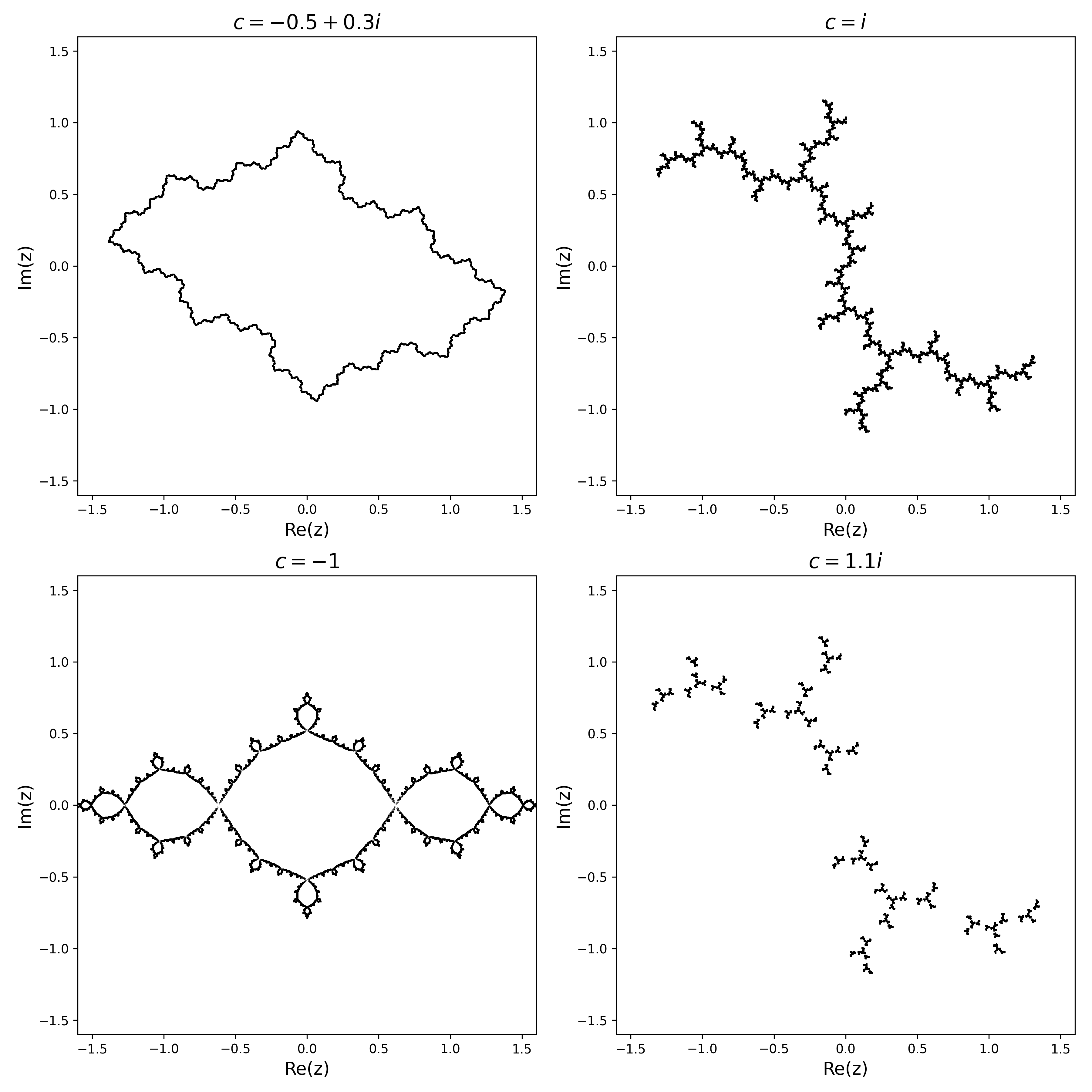
julia.mfrom Teams to plot the Julia set for the four values of the parameter .(a) What do the black points represent? To answer this question, first try and figure out how the code goes about approximating the Julia set. It is a tricky thing to do because, as you recall, the Julia set consists of points which are repelling…
(b) For which of these values of is the set connected, and how do you know?
(c) For each value of , what bounded orbits are attracting? Turn in a single picture with 4 figures, and answers to these questions.
A
code approximates via inverse iteration. for , backward map is . points on the Julia set are repelling under , so they’re attracting under . starting from an unstable fixed point (which lies on ), code iterates backward, randomly choosing either or branch of sqrt at each step. after discarding transients, the iterates densely fill out .
black points are approximations of points on the Julia set , generated by this backward orbit.
B
is connected iff is in the Mandelbrot Set, i.e. iff the critical orbit ( under ) is bounded.
- : orbit converges to attracting fixed point . - connected
- : eventually periodic, bounded. - connected
- : period-2, bounded - connected
- : , , escapes - disconnected
C
- : attracting fixed point at , multiplier .
- : no attracting bounded orbit. critical point is preperiodic (), landing on a repelling 2-cycle. Misiurewicz point; is a dendrite, no Fatou components.
- : superattracting period-2 cycle ; critical point is on the cycle so multiplier is 0.
- : no attracting bounded orbit, orbit of 0 escapes, only attractor is .
Code
I used gemini to convert julia.m into a python equivelant, as it is a more familiar language for me. After converted further modifcations were done by myself.
Figure