Problem 1
Question
Let be a continuous, differentiable map. Assume is a sink and is the largest interval that lies entirely inside the basin of . The points and are not in the basin of .
(a) What are the possible trajectories of the points and ?
(b) What are the possible Lyapunov numbers for each of , , ?
A
is the max interval for ‘s basin. .
by contradiction: suppose . then , so , putting in the basin. impossible! so . same for .
since orbit of (resp. ) can never enter , our possible trajectories are:
- fixed: or
- period-2: and
- eventually fixed: one maps to the other which is fixed, say where
- divergent: orbit escapes to
Answer
both and must map outside since orbits either settle to fixed/periodic on boundary, or will diverge.
B
for : fixed point, orbit is . so:
is a sink implying , so .
for and : suppose . then orbit of converges to some attracting set . the basin of is open, so it contains a neighborhood . but basin of , meaning those points converge to . impossible! contradiction
same argument for .
Answer
equality if boundary points neutral, if repelling or divergent.
Problem 2
Question
Show that if the Lyapunov number of the orbit of under is , then the Lyapunov number of the orbit of under is , whether or not is periodic. Note that if the orbit of under is then the orbit under is .
lyapunov number for under :
orbit under : . lyapunov number under :
chain rule yields
so the product over terms of unfolds into the product over terms of :
substituting:
set . since exists, limit along sub sequence is :
Answer
. the chain rule collapses the product into the product, and the exponent becomes , pulling out the th power.
Problem 3
Question
Begin by sketching and considering cobweb plots of typical orbits.
(a) What are the possible bounded asymptotic behaviors for all ?
(b) Find the Lyapunov exponent shared by most bounded orbits of .
(c) Do all bounded orbits have the same Lyapunov exponent?
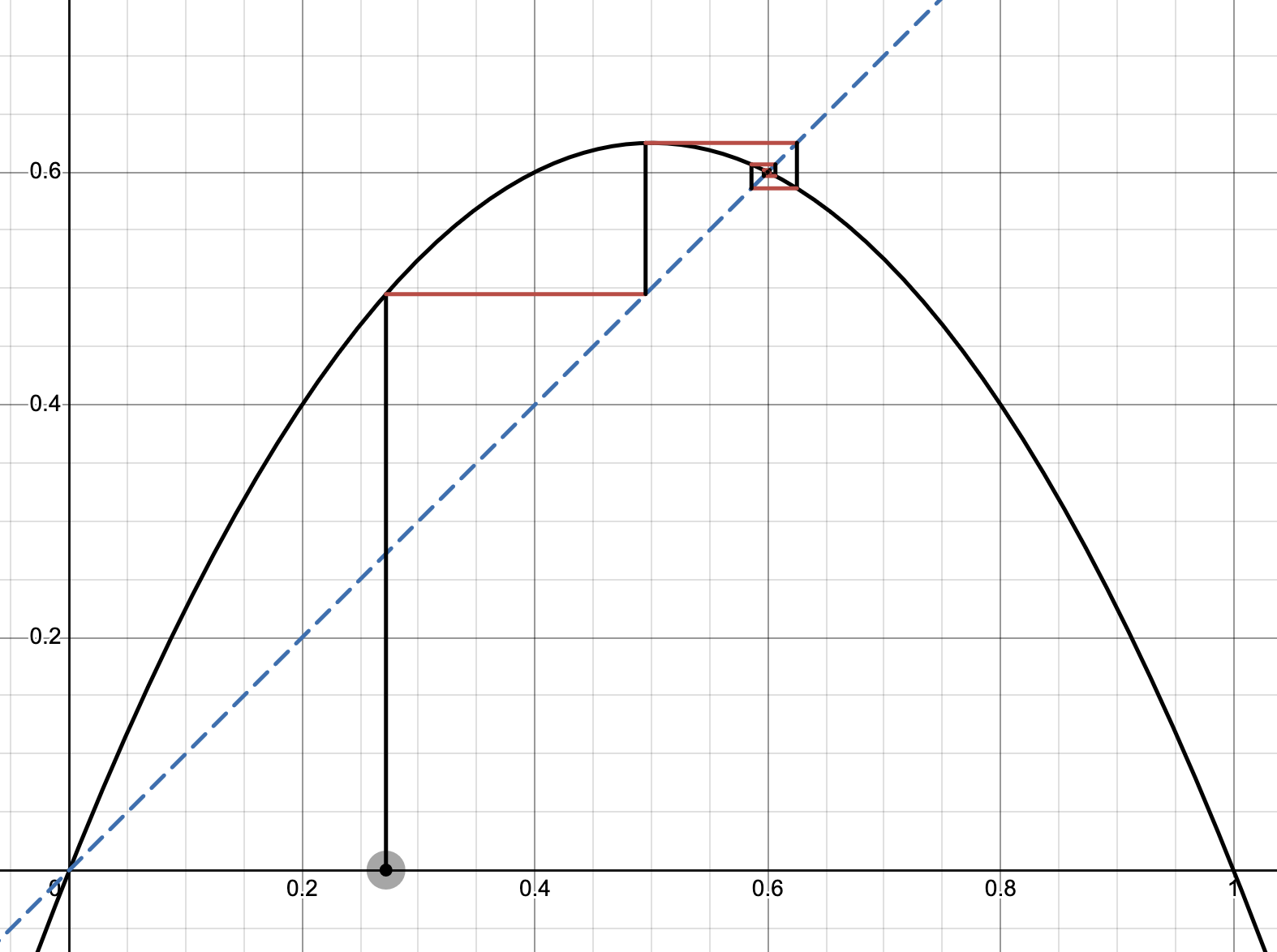
. Logistic Map variant, vertex at , roots at and maps .
.
fixed points:
so and .
stability:
is repelling, - , is attracting
since , were below first period- doubling bifrication. no periodic orbits exist beyond fixed points.
A
for : cobweb spirals into (negative derivative yields alt approach). every orbit in converges to .
for : if , then . if , then , so iterates grow without bound. orbits diverge to .
Answer
bounded asymptotic behaviors:
- convergence to attracting fixed point (generic — all of )
- fixed at only repelling at exactly 0
- eventually fixed at ()
B
most bounded orbits converge to . once near the fixed point, , so:
Answer
C
no. the repelling fixed point has:
and eventually maps to , so its lyapunov exponent is also .
Answer
not all bounded orbits share the same exponent. the measure-zero set has , while the generic orbit has .
Problem 4
Question
Begin by sketching and considering cobweb plots of typical orbits.
(a) Find a conjugacy between and .
(b) Use the conjugacy to find the fixed points and period-2 orbits of (if they exist) and determine their stability.
(c) Show that has chaotic orbits.
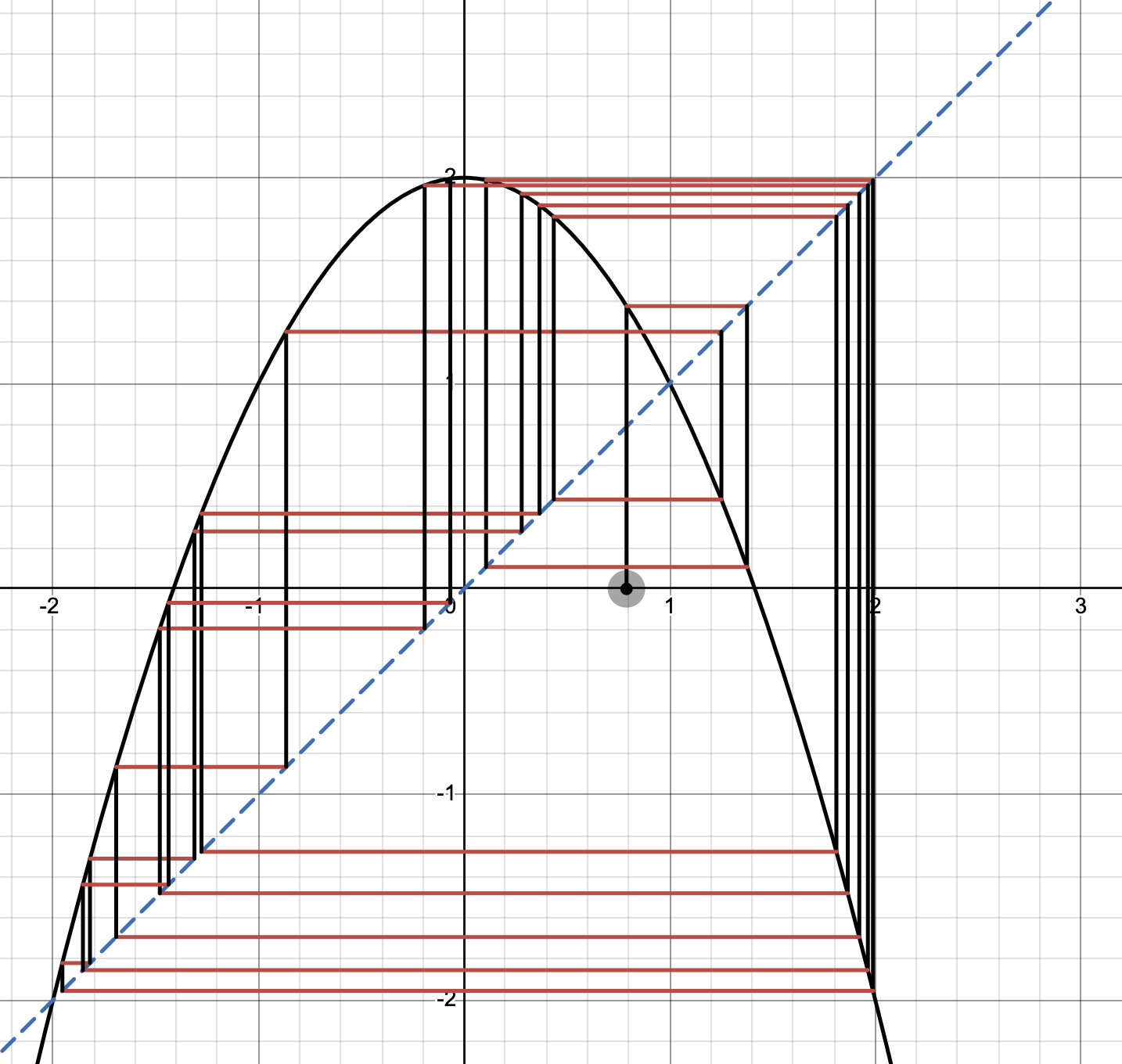
. downward parabola, vertex at , roots at . desmos graph shows chaotic behavior everywhere except 1 ( on rough explorations ). Bounded between -2 and 2.
A
want such that . try affine .
matching coefficients:
:
:
: ✓
Answer
, maps .
B
fixed points of : , so and .
map through conjugacy:
- → - yes
- → - yes
stability via :
- , - repelling
- , - repelling
period-2 orbits of : fixed points of minus fixed points of . setting and factoring out the known roots:
period-2 points from the quadratic:
map through conjugacy:
so the period-2 orbit of is — the golden ratio and its conjugate.
verify: ✓ (using ).
stability:
→ repelling.
Answer
fixed points: (repelling), (repelling). period-2 orbit: (repelling). all periodic orbits are unstable.
C
is affine, so everywhere. from the conjugacy relation:
derivatives along corresponding orbits are identical. so lyapunov exponents are preserved exactly.
is chaotic on : has orbits of every period (HW4 Problem 1), lyapunov exponent for almost every orbit.
since is a topological conjugacy preserving sensitive dependence, dense periodic orbits, and transitivity:
Answer
is chaotic on . conjugacy to gives (sensitive dependence) and periodic orbits of every period. the cobweb had this visually with never settling orbits
Problem 5
Question
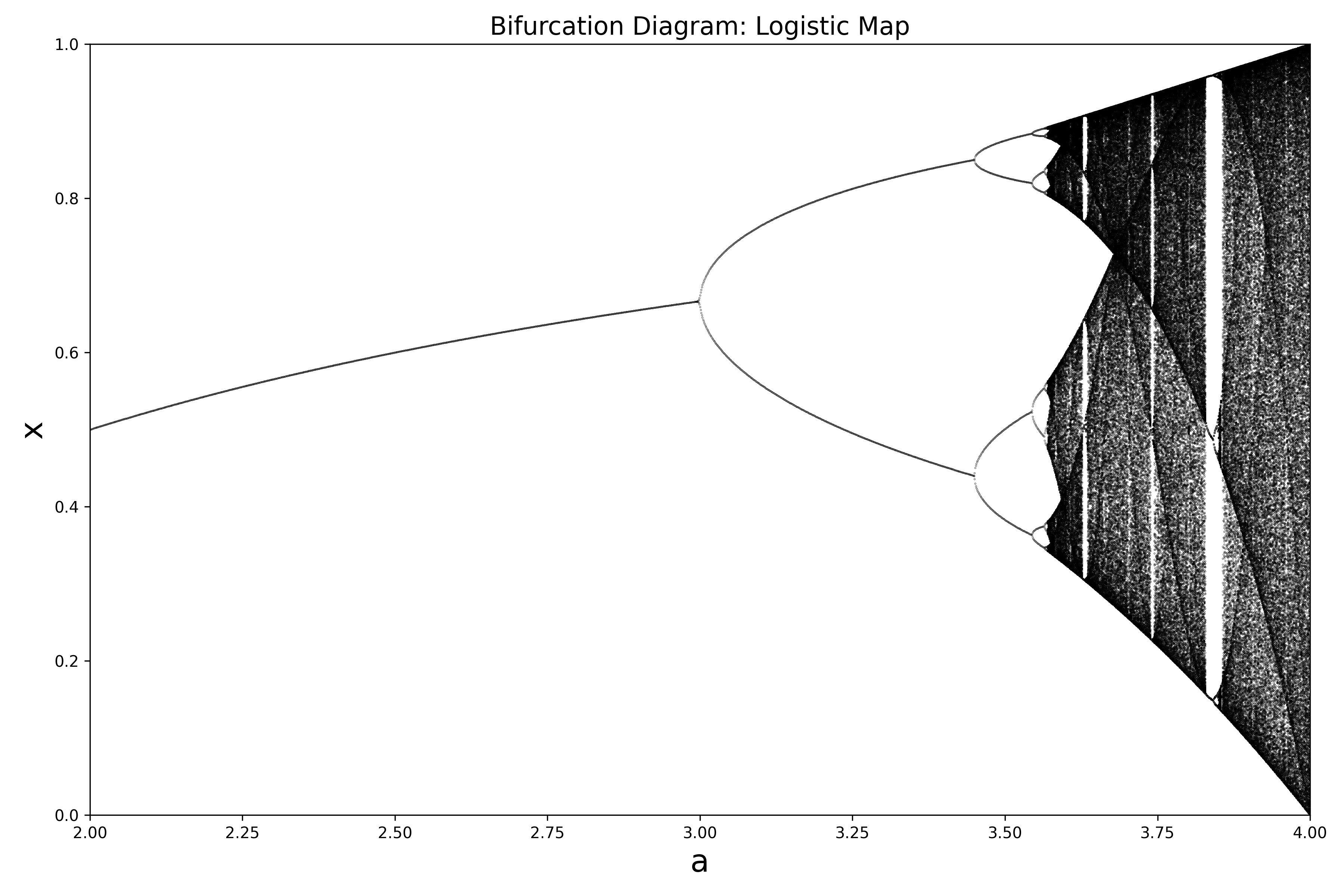
(a) Write a program to draw the bifurcation diagram for the logistic map for in increments of . Iterate times from a random . Plot the bifurcation diagram.
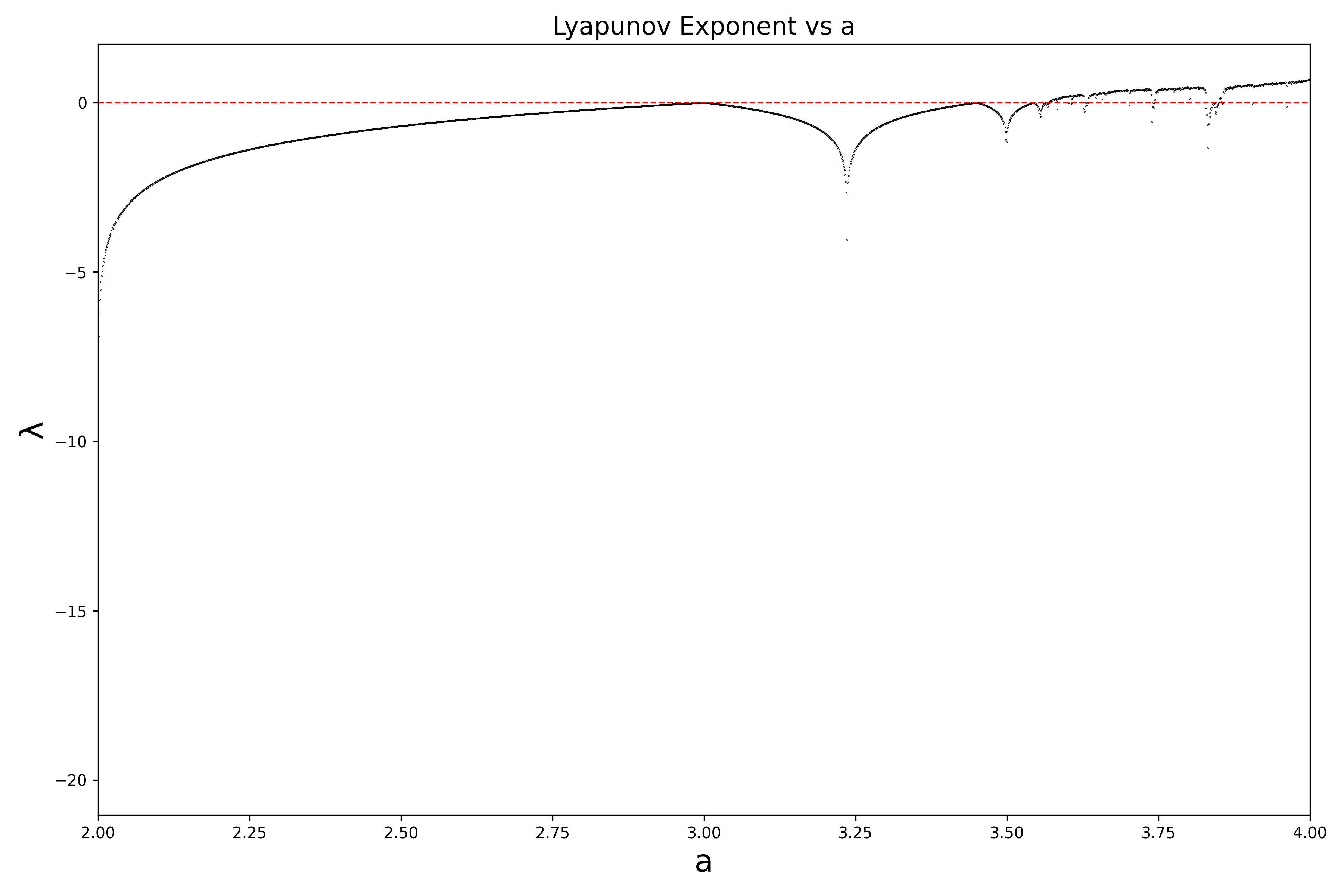
(b) Use iterates 101 to 1000 to approximate the Lyapunov exponent for each . Graph vs with a horizontal line at .
(c) What do you learn from comparing the two pictures?
(d) Why does the Lyapunov exponent appear to bounce off zero several times before becoming positive?
(e) Will a new random produce the same figure? Why or why not?
C
two figures show that where , bifurcation diagram yields clean bands (stable periodic orbits). where , diagram shows dense chaotic scatter. crosses zero exactly at bifurcation points where stability is lost.
periodic windows in the chaotic regime (e.g. the period-3 window near ) show up as sharp dips of below zero in the lyapunov plot.
the lyapunov exponent is quantitative version of what bifurcation diagram suggests: = order, = chaos.
D
each “bounce” off zero is a period-doubling bifurcation. at the bifurcation point, the eigenvalue of the periodic orbit passes through , so and .
between successive bifurcations, the new orbit is stable (). as increases, back to for next doubling. bounces get closer together (feigenbaum scaling) until accumulation point where chaos begins, crosses above zero.
E
yes, a new random produces the same figure. the logistic map has a unique attractor for each , and almost every orbit converges to it regardless of initial condition. the lyapunov exponent is also identical for most
only exceptions are measure-zero sets, in that, exact unstable periodic points / their pre imgs. random hits these with zero probability.
Cod
Figures