Question 1
Let p be a fixed point of a nonlinear map . Given an , find a geometric condition on under which all points in are in the basin of . Use cobweb plot analysis to explain your reasoning. Hint: By geometric condition, I mean some constraint on and/or in the neighborhood of . One example condition that you can improve upon:
In more words and less notation: provided remains between the lines and in the epsilon neighborhood of , all points in the neighborhood are in the basin of . This question is deeper than you may think at first, and showing your condition works for a single example is not proving that it works for all example functions f . Your condition needs to work for all f .
Answer
Geometric Condition
We can use the local stability criterion as our geometric condition:
Cobweb Plot
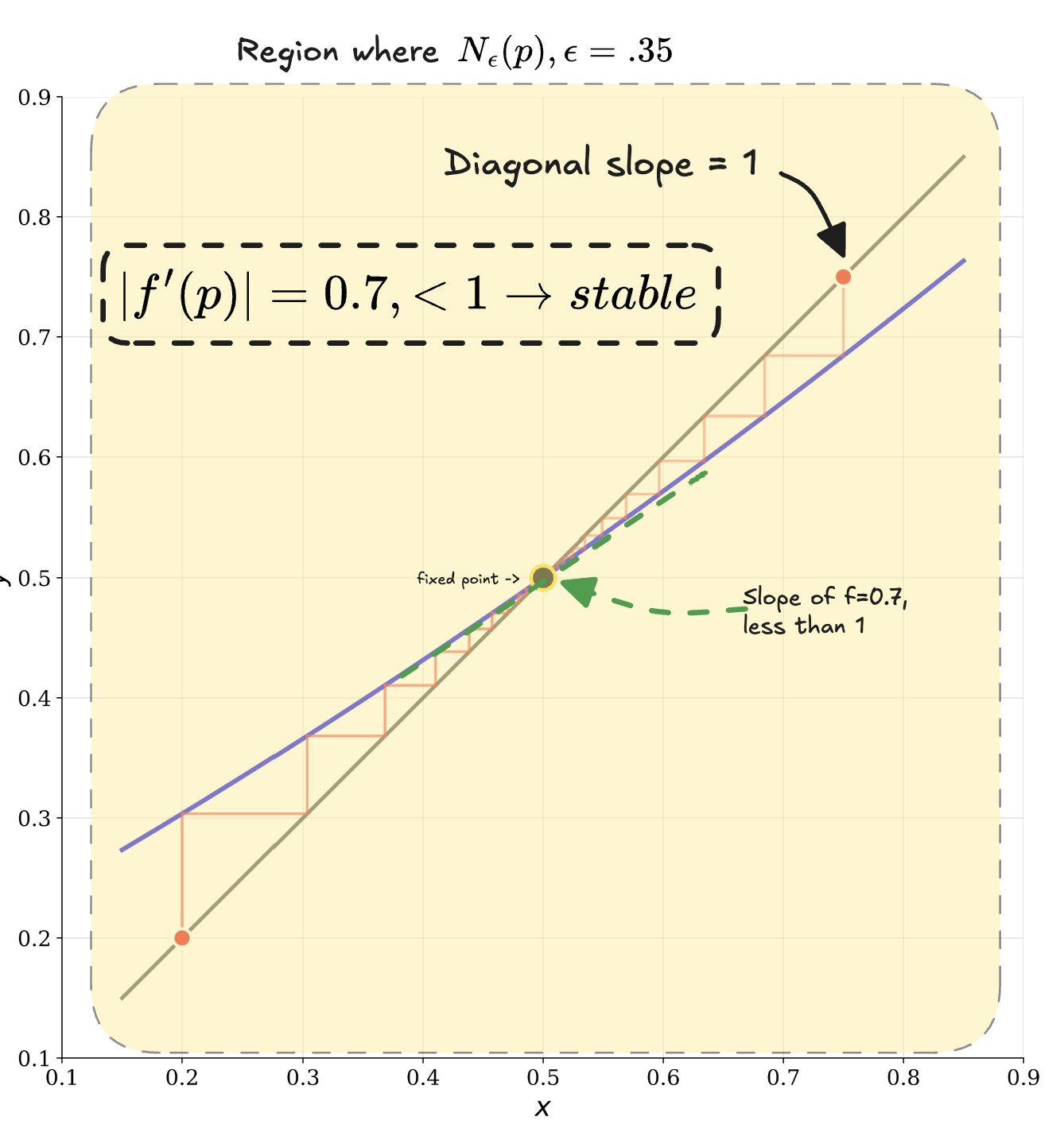
In the plot below, we start from two different pointsi within the region. Iterations lead inward toward the sink, and since curve (in blue) crossed with a shallow slope less than 1, we can ensure that the iterations will converge.
Proof
We now prove this condition guarantees convergence for all functions .
Pick some value of :
Thus by the continuity of , some in the neighborhood , we have:
We can then apply the Mean Value Theorem, such that for any in the neighborhood of , between and such that:
And, since by definition of a fixed point, and geometric conditions states that , we get:
We then repeat the contraction for all ( could be done with something like the Banach Fixed Point Theorem ), such that each time we reapply ,the distance from will shrink by at least :
Thus, because , we see , therefore:
Result
Question 2
The map on has fixed points at and .
- Find a period two orbit for f by solving f 2(x) = x for x.
- What is the stability of the orbit?
Hint: For this problem and the next, you will need to factor a degree 4 polynomial. This can be done by hand without any horrific formulas if you think about what you already know about the roots. 1
Answer
Finding Period Two Orbits for
Compose:
Then plug into :
Factor polynomial
And given that we know the fixed points are and , and has been factored out, we can divide by to find the rest of the roots.
Plugging into quadratic formula:
Yielding:
Answer
Finding Stabllty
To find stability, we have to find derivatives of and :
Derivative of :
Plug in two orbit points:
Calculate the value
Answer
Orbit is unstable as
Problem 3
Let
- Find the fixed points and period two points of and demonstrate that they are sources using and/or .
- Continue the periodic table for begun in Table 1.3. In particular how many periodic orbits of (minimum) period k does G have, for each k ≤ 10?
Hint: The pattern is not simple. Your table should look something like this:
| Period | Number of fixed points of | Proper divisors of | Number of fixed points due to periods | Number of fixed points due to peiod only | Orbits of period |
|---|---|---|---|---|---|
| 1 | 2 | 1 | 0 | 2 | 2 |
| 2 | 4 | 1 | 2 | 2 | 1 |
| 3 | 8 | 1 | 2 | 6 | 2 |
| 4 | 16 | 1,2 | 4 | 12 | 3 |
| 5 | |||||
| 6 | |||||
| 7 | |||||
| 8 | |||||
| 9 | |||||
| 10 |
Answer
Fixed Points and Period Two Points
We can find the fixed points with :
Thus fixed points are and .
Finding stability with derivative:
For , , and is thus a source.
For , , and is thus a source.
To find the period 2 orbit, we plug into :
and factor:
and since is also a root:
We can now use them to construct the period two orbit via quadratic :
And then we can find the stablity with derivatives:
Answer
thus period two orbit is a source.
Table Completion
Here is the completed table:
| Period | Number of fixed points of | Proper divisors of | Number of fixed points due to periods | Number of fixed points due to peiod only | Orbits of period |
|---|---|---|---|---|---|
| 1 | 2 | 1 | 0 | 2 | 2 |
| 2 | 4 | 1 | 2 | 2 | 1 |
| 3 | 8 | 1 | 2 | 6 | 2 |
| 4 | 16 | 1,2 | 4 | 12 | 3 |
| 5 | 32 | 1 | 2 | 30 | 6 |
| 6 | 64 | 1,2,3 | 10 | 54 | 9 |
| 7 | 128 | 1 | 2 | 126 | 18 |
| 8 | 256 | 1,2,4 | 16 | 240 | 30 |
| 9 | 512 | 1,3 | 8 | 504 | 56 |
| 10 | 1024 | 1,2,5 | 34 | 990 | 99 |
Question 4
Let , where and are constants. For which values of and does have
- an attracting fixed point?
- a repelling fixed point?
- a neutral point?
Answer
Before any sub questions, lets solve for fixed points
Derivative must also be a constant from the linearity of :
THe only thing affecting stability here will be , regardless of or fixed point.
Attracting Fixed Point
By definition an attracting fixed point must satisfy
Therefore:
Answer
Repelling Fixed Point
By definition a repelling fixed point must satisfy
Therefore:
Answer
and also can be any real value.
Neutral Fixed Point
By definition a neutral fixed point must satisfy
Answer
And when , a fixed point at for any real
For when , if , every point fixed, else no fixed points exist.
Question 5
Let be the eight fixed points of where . Clearly .
- For which is ?
- Group the remaining six points into two orbits of three points each.
Hint: It may help to consult Figure 1.10(c). The most elegant solution uses the chain rule. You need not compute the actual values of the xi
Answer
Finding Index of where Midpoint is 3/4
Not sure if this is “cheating” or not, but Figure 1.10C does seem to just show the ordering of fixed points for .
Visually, it seems as though there are 5 fixed points less than 3/4, and thus:
Answer
Grouping Remaining Points into Orbits
The other 6 points form two period 3 orbits. Lets define them:
Orbit 1:
Orbit 2:
Chain rule yields that any point in one of these period 3 orbits () where , , , …, we get:
It is the same product for all 3 points independent of order.
We can compute with each to see if they yield the same value, but we can sort of infer this from the figure, just that points alternate in their sign but vary in magnitude. Points belonging to the same orbit will have the same derivative value for .
Thus:
Answer
Orbit 1:
Orbit 2:
We can very by computing at each point, but it is not exactly necessary.